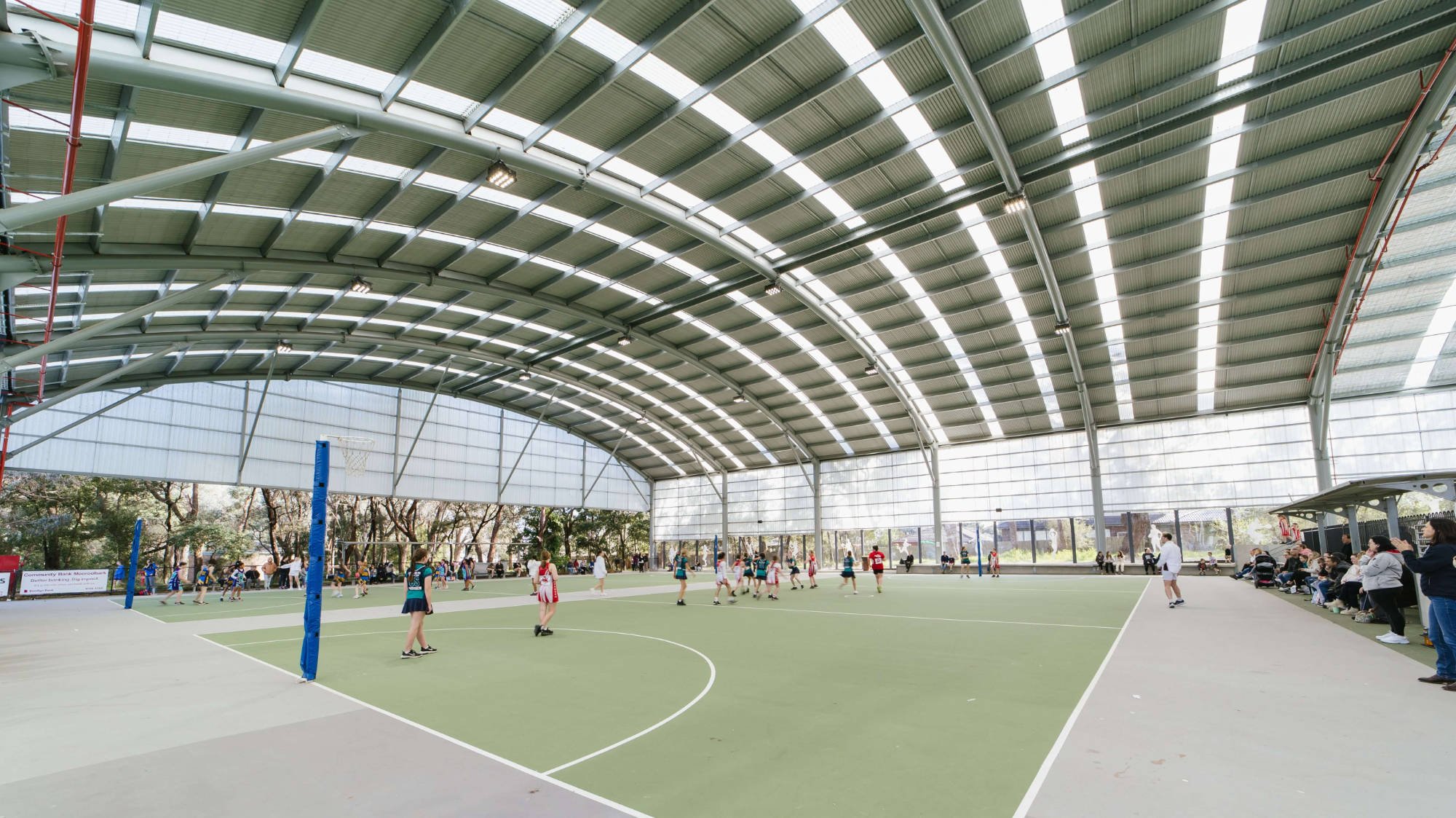
Designing an indoor sports facility starts with a clear understanding of how the space will be used in practice. The type of sport, competition level, and user groups all shape key decisions around spans, clearances, court dimensions, circulation, storage, and spectator provision.
Facilities designed for multi-code community use have very different requirements to a performance-focused training venue or competition hall. Defining those requirements upfront helps align design intent with buildability, compliance, and long-term operational needs.

Every sport sets its own standards for court size, clearances, flooring performance, and run-off zones. If competition use is planned, these technical requirements must be designed in from the start.
Multi-code facilities need careful coordination between overlapping standards. Early decisions around floor systems, line marking, lighting levels, and ceiling heights avoid compromises that affect safety, play quality, and compliance later.

Multipurpose indoor facilities are designed to host several sports and event formats within one footprint, improving utilisation and making capital spend work harder across programs and community use.
Flexible layouts, retractable seating, durable floor systems, and adaptable lighting allow spaces to shift between training, competition, and events without costly reconfiguration or operational friction.

Local climate influences insulation, ventilation strategy, heat load management, and material selection, even for indoor facilities. These decisions affect comfort, durability, and operating costs over the life of the building.
Energy-efficient HVAC, LED lighting, and solar integration reduce running costs and improve environmental performance. Early modelling helps balance upfront spend with long-term savings and operational resilience.

It is vital to have an inclusive design that considers accessibility for all, including people with disabilities. This includes accessible entrances, pathways, locker rooms, and seating areas.
Safety is a critical aspect of building an indoor sports complex. It involves the building's structural integrity and design, the quality of the materials, proper lighting, ventilation, and emergency exits.

We deliver projects on time, within budget, and to the highest quality standards.
With the design in place, the next phase is construction. Typically, this phase involves a range of professionals, including architects, engineers, and construction managers. You need a project manager to guarantee that all these people work together to ensure the project meets the specified standards and is completed on time and within budget.
Typically, this management burden falls on you alongside your daily responsibilities. However, Greenline’s Consult. Design. Construct. methodology allows you to step back while we manage the entire project. You are provided with a single point of contact from inception to completion, as we handle every detail in-house.

The success of indoor sports facilities depends on construction teams that understand the technical demands of sports environments.
Specialist experience helps anticipate constraints, coordinate trades, and resolve issues early so delivery stays controlled and predictable.

Project costs vary based on scale, material quality, and site location. Establishing a detailed budget early is vital for long-term feasibility.
Greenline’s progressive budgeting provides total financial clarity. We monitor expenses and identify deviations early to ensure timely adjustments.

Project cost is driven by scope, structure, services, materials, and site conditions, which is why early definition of requirements matters.
Our three-phase methodology offers a cost and timeline guarantee. We use in-house inspections to ensure every detail meets your exact standards.
At Greenline, we understand the complexities of designing and constructing indoor sports facilities. Our team is committed to delivering projects that meet the highest quality, functionality, and sustainability standards.
Whether planning a new sports complex or upgrading an existing facility, we have the expertise and passion to make your vision a reality.