
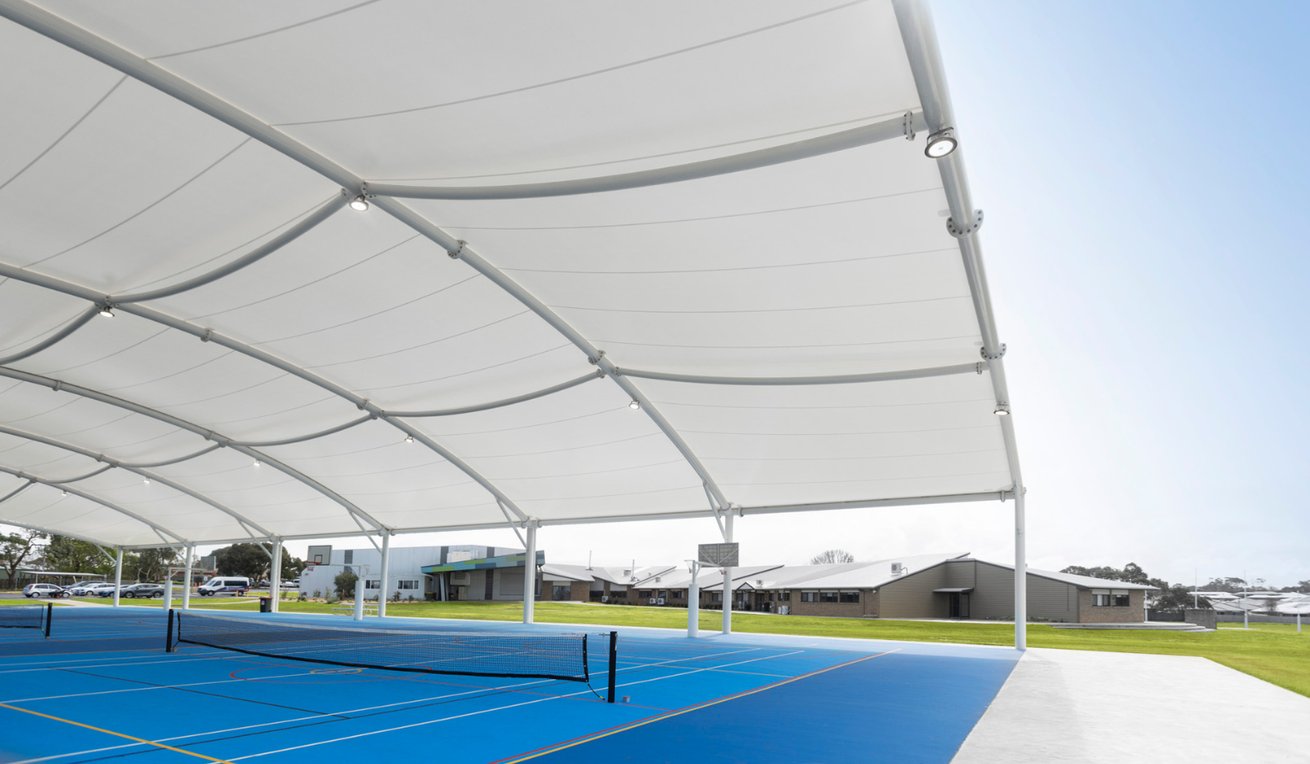
Every time rain, heat, high UV, or any adverse weather event shuts down your tennis court, you're reminded that the surface isn't protected. It's exposed, wearing down, and costing you usable days.
Most clubs, and schools, start out reactive: sweep the leaves, hose the dust, patch the crack that is suddenly too big to ignore. Then a full week of sport gets washed out, a player slips on algae near a drain that has never really worked, or parents start asking questions about sun exposure.
This is where the court goes from "it's fine" to "we need to do something about this" quickly.
This guide gives you a practical framework for tennis court protection: where simple maintenance is enough, where design decisions are causing the damage, and when a covered, all-weather court is the smarter long-term move. If you're a business manager or facilities manager trying to work out what your courts actually need, this should help you separate the quick wins from the capital projects.
Why tennis court protection matters
Tennis court protection is about protecting an asset that your club, school, or community relies on for scheduled programming.
An unprotected court creates real problems. Players may slip on wet surfaces or algae. UV exposure becomes a duty-of-care concern for students and members. Rain cancels fixtures and throws timetables into chaos. The surface itself wears out faster, bringing forward costly resurfacing or reconstruction that could have been delayed with better protection.
In Australia, the combination of high UV, unpredictable rain, and rising expectations around safe facilities makes this more pressing than in most countries. We face increasing scrutiny around sun protection during outdoor activities. You lose bookings when courts are unusable due to the weather. And you end up spending more on reactive repairs that could have been prevented with basic routines.
Protection also means getting more from what you already have. A well-maintained, covered court can host assemblies, outdoor learning, and community events alongside sport. That's a far better return on an existing asset than building new facilities from scratch.
It's the reason why a number of covered sports court projects we deliver are retrofits over existing courts, not new builds.
The most reliable outdoor sports facilities have protection designed in from the start. But existing courts can be improved with the right combination of weatherproofing, drainage, and maintenance routines.
Weatherproofing: covers, canopies, and roof systems
Types of tennis court covers and roof systems
Fabric tensile structures use engineered steel frames and high-performance membranes to create large, column-free spans. Barrel vaults and arched canopies are common configurations. These provide waterproof protection while allowing natural light through: translucent membranes filter UV without making the space feel dark or enclosed. They're lighter than traditional buildings, which often means faster installation and lighter footing requirements. These structures also require limited maintenance, relying mostly on regular cleans.
Large-span steel roof structures deliver robust, long-term weather protection. Gable, curved, and skillion profiles can be designed to suit different site constraints and aesthetics. Hot-dip galvanised steel provides corrosion resistance, and these structures handle heavy wind and rain loads well. Steel structures are commonly used for covered outdoor learning areas and multi-sport courts where durability and low maintenance over decades are priorities.
Partial covers versus full-span covers is a key decision. A partial cover over spectator seating or one end of the court improves comfort but won't solve scheduling problems caused by weather. A full-span cover turns the court into a year-round facility. If your goal is to eliminate weather cancellations and expand how the space is used (assemblies, exams, community events) full coverage is worth the investment.
If you're primarily addressing UV for spectators or break area, a partial solution may be enough.
Design considerations for all-weather court covers
Getting the design right matters as much as choosing the structure type. A poorly designed cover can create new problems (glare, echo, poor ventilation, water pooling at the edges) that are expensive to fix after construction. We've seen this on enough projects to know it's worth getting right the first time.
Orientation affects sun path, wind exposure, and glare. A north-south orientation typically reduces glare for players during morning and afternoon sessions, but your site will have its own constraints. This needs to be assessed early, not assumed from a generic plan. Roof height and clear spans must allow for tennis play without obstruction. Many guidelines recommend at least 9 to 10 metres of clearance at the net, though requirements vary by governing body and competition level. If you're planning for multi-sport use (basketball, netball, volleyball), those sports have their own height requirements that need factoring in.
Drainage integration is critical. The roof needs to channel water away from the court edges, not dump it onto the playing surface or create ponding problems at the perimeter. Poor drainage design can undermine all the other work you've done to protect the court surface. Structural loads must be engineered for local wind and rain conditions. Australia's varied climate zones mean a structure that works in Melbourne may not be appropriate for Townsville. Certified engineering for your specific location isn't optional.
Fabric membranes tend to perform better acoustically, which matters if the space will be used for assemblies or PE (Physical Education) instruction. If acoustics are a concern for your site, that's something we factor into the design early. And if you need artificial lighting for evening use or overcast days, that should be part of the design from the start: retrofitting lighting into a completed structure is more expensive and less effective.
If you want the space to work for school assemblies, line markings need to accommodate that. Spectator areas, storage, and access routes need to be designed in, not retrofitted later. Multi-purpose use adds real value, but only if it's planned upfront.
What a well-designed cover delivers
A cover reduces surface wear by keeping standing water and UV off hard courts. That extends the interval between resurfacing and reduces lifetime maintenance costs. The exact savings depend on your surface type and climate, but the principle holds across all hard court surfaces. It also gives you predictable scheduling. When you can confirm the court will be usable regardless of the forecast, timetabling becomes simpler and cancellations drop. If you're managing PE across multiple year groups or running competition fixtures, that scheduling certainty is often the primary reason for covering courts.
Beyond operations, a cover addresses duty-of-care requirements around UV, reduces surface temperature in summer, and eliminates wet-surface slip hazards. You can hold exams, assemblies, and outdoor lessons under cover. Clubs can host events that would otherwise require indoor venues. That kind of flexibility is what turns a covered court from a single-sport facility into a genuine community resource.
Drainage and grading
Drainage problems cause more tennis court failures than most people realise. Water sitting on the surface accelerates wear, promotes algae growth, and creates slip hazards. Water underneath the surface is worse: it leads to sub-base movement, cracking, and eventually structural failure that requires full reconstruction. We see drainage as the first thing to get right on any court project.
Court slope and runoff
Tennis courts need a slight slope to move water off the playing surface. For hard courts, a common target is around 1% gradient (approximately 1cm per metre). That's shallow enough that players don't notice it, but sufficient to prevent ponding.
If your court was built correctly, the slope should be doing its job. Problems arise when settlement occurs over time, when tree roots cause localised lifting, or when the original construction was deficient. Visual cues that your slope or grading is failing include standing water that persists well after rain stops, chronic damp patches in specific locations, and soft spots that suggest sub-base issues.
If you're seeing these signs, surface-level fixes won't solve the underlying problem.
Perimeter drainage
The court surface is only part of the drainage system. Perimeter drains, spoon drains, and nearby pits need to capture and channel water away from the court efficiently. We regularly see blocked or undersized perimeter drainage on sites we work on.
A basic maintenance routine should include clearing leaves and debris from grates regularly (especially in autumn), checking outlets and discharge points for blockages, and monitoring how the system performs after heavy rain. If water is backing up or overflowing during normal rain events, the system either needs cleaning or the capacity isn't sufficient for your site.
Poor drainage around the court edges doesn't just cause puddles. Over time, it undermines fence footings and erodes the sub-base at the court perimeter: problems that are expensive to fix once they've progressed.
When drainage needs engineering, not maintenance
Some drainage problems can't be solved with cleaning and minor repairs. If you're seeing repeated ponding in the same spots despite clearing drains, sub-base movement or depressions, cracks that return quickly after patching, or evidence of heaving, you're past the point of simple fixes.
At this stage, a specialist assessment is needed. A civil engineer or sports court builder can tell you whether the sub-base needs reconstruction or whether targeted repairs will work. If you're considering a covered structure at the same time, an integrated approach makes sense.
One team responsible for aligning the structure, surface, and drainage into a single plan, rather than trying to coordinate separate contractors and hoping the pieces fit together. The ground is the most important part of the build (it supports the surface and the structure), so we do always ensure that the soil, the drainage, the slope, and all potential risks, are accounted for and taken care of.
Routine maintenance
Good maintenance extends surface life, reduces safety risks, and keeps the court looking professional. The key is consistency: small, regular tasks prevent the buildup of problems that lead to expensive repairs.
Regular cleaning
After use, a quick visual inspection for debris, glass, or hazards takes a few minutes but prevents staining and slip hazards. Weekly, blow or sweep leaves and accumulated debris, check the net and posts for damage or looseness, and light-wash heavily used areas if needed. Aligning this with existing grounds maintenance schedules keeps it manageable without adding another task to someone's list.
Mould, mildew, and algae
Algae and mould typically appear in shaded areas, near drains, and anywhere water sits for extended periods. They create slip hazards and make the court look neglected.
Safe cleaning depends on your surface type. For hard courts, a diluted cleaning solution with soft-bristle brushing is usually appropriate. Pressure washing should be used cautiously: high pressure can damage acrylic surfaces and force water into cracks, which accelerates sub-base damage.
The spots near drains and at shade lines need attention more frequently than the centre of the court. Addressing mould and algae early is straightforward. Letting it establish is harder and more expensive to deal with.
Seasonal checks
Before the wet season, check drainage and perimeter drains, inspect the surface for cracks and low spots that need patching before water sits in them for months, and verify fence and gate hardware is secure. Before summer, monitor for surface softening and colour fade on acrylic courts, and assess whether additional shade or watering is needed to manage surface temperature. Aligning these checks with school terms or club seasons ensures the court is ready when demand is highest.
Equipment, nets, posts, and lighting
Net and post maintenance involves checking tension, centre strap condition, and anchor security. Loose nets affect play quality and look unprofessional. Damaged posts can be a safety hazard, particularly on school sites where younger students may lean on or climb fencing.
Lighting should be inspected for blown globes, lens clarity, and pole condition. If your court has integrated lighting, ensure it provides even coverage and that line markings remain visible under artificial light.
Surface repair and preservation
Identifying and sealing cracks
Hairline cracks are surface-level and can usually be sealed with appropriate filler. Structural cracks are wider and often indicate sub-base movement: sealing them without addressing the cause means they'll return. Tree-root cracks follow distinctive patterns near the court perimeter and will recur unless the root problem is addressed.
Early intervention matters because water enters through cracks and damages the sub-base. A small crack sealed promptly costs almost nothing to fix. The same crack left for a year can lead to localised sub-base failure that requires major repair.
If a crack is less than a few millimetres wide, stable, and not growing, it's usually a routine repair. If it's wider, growing, or part of a pattern of cracking across the surface, get a specialist assessment before spending money on patching that won't hold.
Resurfacing intervals
Hard courts in active use typically need resurfacing every 4 to 8 years, depending on usage intensity, UV exposure, and maintenance quality. This isn't a fixed rule: some courts last longer, some need attention sooner.
Warning signs you're past due include widespread colour loss or fading, polished or slippery patches that don't respond to cleaning, and multiple patch repairs that keep failing. If patches aren't holding, the issue is usually the broader surface condition rather than the individual repair.
Resurfacing is an opportunity to address other issues at the same time. If drainage, lighting, or fencing also needs work, coordinating everything into one project is more efficient than handling each element separately across multiple budget cycles.
Line markings and run-off areas
Line markings need to be bright and clearly visible for safety and compliance. Faded lines create confusion during play and look unprofessional. If your court is used for multiple sports, clear differentiation between line sets (using colour or line weight) helps players and reduces disputes.
Run-off areas and surroundings are part of the protection plan. Trip hazards from uneven surfaces, puddles that form at court edges, and erosion around fencing all create risks.
Treat these areas as part of the court, not as separate maintenance problems.
Protection by surface type
Hard courts (acrylic, asphalt, concrete)
Hard courts are the most common type in Australian schools and clubs. Their main vulnerabilities are UV degradation, surface cracking, and water ingress.
Regular cleaning and debris removal prevents abrasive damage. Prompt crack sealing stops water from getting into the sub-base. Managing water flow off and around the court prevents sub-base damage and settlement.
A cover structure extends hard court life by reducing UV exposure and eliminating ponding. If covering the court isn't currently feasible, good drainage and regular resurfacing schedules become even more important: the surface is doing all the weathering work by itself.
Clay and grass courts
Clay and grass courts have specialised maintenance requirements beyond this guide's scope. A few points are relevant to protection decisions, though.
Clay courts require consistent moisture levels and regular rolling, brushing, and smoothing. A cover affects how moisture is managed on the surface, so partial covers that allow some weather exposure may be preferable to a full enclosure, depending on how the court is maintained.
Grass courts need regular mowing at appropriate heights and good turf health. Shade from a cover can promote moss growth and create soft spots if not managed carefully. If you're protecting clay or grass courts, consult specialists who understand those surfaces specifically.
Synthetic turf
Synthetic turf courts require attention to infill levels and distribution (sand or rubber that keeps the fibres upright and affects play characteristics), brushing patterns (to lift matted fibres and redistribute infill), and edge details and seams (to prevent trip hazards and water ingress).
Covers can extend synthetic turf life by reducing UV degradation. They can also increase heat buildup underneath (especially metal roofs), which affects playing comfort and surface temperature. Balancing these factors is part of the design conversation if you're considering a cover over synthetic turf.
When to upgrade to a covered all-weather court
Frequent weather cancellations that disrupt timetables, training schedules, or competition fixtures are the clearest signal. The time you spend rescheduling and communicating changes has a real cost that doesn't show up on the maintenance budget. Persistent drainage issues or slippery patches despite regular maintenance suggest underlying problems that surface repairs won't solve, and continuing to patch without addressing root causes wastes money.
UV and heat concerns raised by parents, staff, or players point to duty-of-care obligations that aren't discretionary, particularly in school settings. And if your court sits empty on hot days, rainy weeks, or during UV-intense hours, you're getting a limited return on the facility.
When several of these factors stack up, a covered court is the logical next step.
What to look for in a delivery partner
If you decide to pursue a covered court, choosing the right delivery partner matters more than choosing the right structure type. The structure can be designed to suit your site. The delivery model determines whether the project runs smoothly or creates headaches.
Look for one point of accountability: when one team handles consultation, design, engineering, and construction, problems get solved because there's nowhere to hide. You're not spending your time coordinating between an architect, an engineer, and a builder. Progressive budgeting with a clear scope means you know what you're getting and what it costs before construction starts. Watch out for quotes that exclude footings, drainage, or site preparation: these can add significant unexpected costs that blow the budget after you've already committed. Quoting is not the first step. The first step is understanding your needs, vision, and the site specificities and constraints.
Your structure needs to be engineered for local conditions. Wind loads, corrosion factors, and UV exposure vary across Australia. A structure designed for a sheltered suburban site may not perform in an exposed coastal or regional location. And if you're a school or club that can't shut down operations during construction, your delivery partner needs to understand how to work on occupied sites: scheduling around terms and seasons, using offsite fabrication to minimise time on site, and protecting your schedule and your people.
Our approach to tennis court protection
We've delivered outdoor sports facilities for schools, clubs, and councils across Australia since 1997. Our approach is to help you get the right solution for your situation rather than default to the most expensive option.
Consult. Design. Construct.
We follow a structured approach. Our methodology brings consultation, design, and construction together under one point of accountability.
Consult starts by understanding how you actually use your courts, what problems you're trying to solve, and what constraints you're working within. This is where we work out whether improved maintenance, a shade structure, or a full covering system is the right response. Not every site needs a full roof, but if it does, better to know that early and budget accordingly.
Design is performance-led, factoring in weather patterns, orientation, glare, acoustics, multi-use requirements, and integration with existing facilities. Because design and construction sit under the same contract, our design team knows what's buildable within the budget from the outset.
Construct is handled by one team from start to finish. Live-site construction is planned around school terms or club seasons, with offsite fabrication used to minimise time on site and disruption to daily operations.
The budget is built progressively with site realities included from the start. Once the scope is agreed upon, pricing is locked in with no surprises.
Frequently asked questions
Is a cover necessary for my climate?
It depends on what problems you're solving. In areas with high UV, frequent rain, or extreme heat, a cover improves usability and reduces maintenance costs. Even in milder climates, a cover enables year-round scheduling certainty and expands how the space can be used. The decision comes down to whether the utilisation gain and reduced maintenance justify the investment for your specific site.
Can I pressure wash my tennis court without damaging it?
Pressure washing can damage acrylic surfaces if the pressure is too high or the angle is wrong. It can also force water into cracks, which accelerates sub-base damage. If you need more than soft-bristle brushing and mild detergent, consult your surface manufacturer's guidelines or a specialist before proceeding.
What's the ideal fence height for a school tennis court?
Most tennis courts use chain-link fencing at 2.7 to 3.6 metres, depending on the setting and intended use. For your site, durability and low maintenance are priorities. Coated chain-link resists corrosion better than galvanised alone. Gate positions should manage access and foot traffic patterns, not just provide entry.
Do I need council approval for a covered tennis court?
In most cases, yes. Covered structures typically require development approval, which may involve site assessment, engineering certification, and compliance with local planning controls. We can identify approval requirements early and factor them into the project timeline.
Can one court accommodate multiple sports?
Multi-sport line markings can accommodate tennis, netball, basketball, and volleyball on the same surface. Colour coding and different line weights help differentiate the sports. If you're installing a cover, ensure the roof height accommodates all intended uses: basketball and volleyball have different clearance requirements to tennis. Design the space for multi-sport use from the start, as retrofitting additional shade structures later is more difficult and more expensive.
Next steps
If you only do five things this term
- Walk the court after rain. Note where water ponds, how long it takes to drain, and any soft spots in the surface.
- Clear drains and grates. Remove leaves, debris, and sediment buildup from all drainage points around the court.
- Inspect cracks and surface wear. Mark anything wider than 3mm or showing edge lifting for follow-up.
- Check fencing and gates. Look for rust, bent posts, and latches that don't secure properly.
- Start a maintenance log. If you don't have one, start one. Track cleaning, repairs, and issues so you can see patterns over time.
These five checks take less than an hour and give you a clear picture of where your court stands.
Planning for larger upgrades
If your audit reveals persistent drainage problems, surface failures, or weather-related concerns that routine maintenance won't fix, it may be time to plan for a larger project. Resurfacing, drainage reconstruction, and covered structures are all options depending on your situation and budget.
Book a consultation to review your site and options.
Or use the Project Estimate Tool to explore realistic budgets for a covered sports court.