TL;DR: The research on outdoor learning is settled. It improves engagement, academic outcomes, and student wellbeing across year levels. The real challenge is making it a reliable part of the weekly timetable, not a weather-dependent add-on. Consistent delivery comes down to three things: curriculum alignment, teacher confidence, and outdoor infrastructure that holds up across the full school year.
The hard question here, is not whether outdoor learning works. It is, instead, about what it takes to make it a reliable part of the weekly timetable.
Outdoor learning is a recognised pedagogical approach in the Australian Curriculum. It takes classroom teaching into outdoor and natural environments, and when schools deliver it consistently, it shows up in stronger engagement, better behaviour, improved academic results, and real physical and social development in students.
We've delivered 600+ projects since 2020 and are trusted by hundreds of schools across Australia. In our experience, schools successfully moving outdoor learning from a "weather permitting" activity to a regular curriculum delivery method share a consistent set of conditions: curriculum alignment, teacher confidence, and outdoor infrastructure that holds up across the full school year.
This guide walks through what outdoor learning is in the Australian context, what the research shows about its impact, and what your school needs in place to make it work.
What outdoor learning is
Outdoor learning is a deliberate pedagogical approach where teachers use outdoor environments as the setting for delivering curriculum content that would otherwise be taught indoors. A geography lesson about erosion happens at the creek bed behind the school oval. A maths class on measurement runs on the sports court, with students physically pacing and recording distances. A science investigation into plant life cycles takes place in the school garden rather than on a textbook diagram.
The Australian Curriculum describes outdoor learning through experiences delivered via connected curriculum content, and Outdoor Education Australia describes it as a form of curriculum interpretation that reaches across learning areas. The subject being taught doesn't change.
The environment it's delivered in does, and that change has measurable effects on how students engage with what they're learning.
Outdoor learning and outdoor education are different things
The two terms get used interchangeably, but they describe different approaches. Understanding the distinction matters for curriculum planning.
Outdoor education is a standalone subject. It has its own learning outcomes and typically covers adventure activities, camps, bushwalking, and wilderness skills. Students opt into it, or it appears as a scheduled subject on the timetable.
Outdoor learning isn't a subject at all. The Australian Curriculum frames it as a teaching methodology, a way of delivering existing curriculum content using outdoor environments. As Flinders University researcher Joss Rankin describes, outdoor learning is a pedagogical approach used to achieve outcomes across mathematics, geography, science, and health, where the subject stays the same and the environment changes.
A practical example: a Year 4 teacher running a living-and-non-living-things lesson in a covered outdoor area, asking students to collect specimens, observe insects, sketch what they find, and record data. The learning area is science. The curriculum outcome is unchanged. The outdoor setting is the method of delivery, not the subject being taught.
Framed this way, outdoor learning is accessible to every classroom teacher across every year level without needing a specialist instructor, a camp program, or a bush setting. What it needs is intention, a curriculum connection, and a space where it can happen reliably.
Where outdoor learning sits in the Australian curriculum
Outdoor learning has a formal place in the Australian Curriculum, recognised by ACARA (the Australian Curriculum, Assessment and Reporting Authority). ACARA identifies four interrelated aspects of outdoor learning, developed in consultation with Outdoor Education Australia, and these aspects give teachers a framework for connecting outdoor experiences to curriculum requirements rather than treating outdoor time as separate from formal instruction.
The four key aspects
The four dimensions ACARA outlines work together rather than in isolation. Environment and nature is the foundation, describing direct personal contact with the outdoors in ways that build enjoyment of outdoor activity and genuine familiarity with the natural world, not through occasional excursions but through regular engagement. Self and others covers how students develop awareness of themselves and how they relate to peers in outdoor contexts, which supports the collaborative skills that underpin most outdoor tasks. Safe practices develops risk awareness, hazard identification, and responsible decision-making in outdoor settings. Movement competence connects to physical literacy, helping students build the skills and confidence to participate in a wide range of outdoor activities across their schooling.
A single outdoor lesson can address all four simultaneously. That's why outdoor learning sits as a cross-curricular approach rather than a standalone subject, and why it can thread through most of what schools already teach.
Which subjects connect
Outdoor learning has formal connections to Health and Physical Education, Humanities and Social Sciences (Foundation to Year 6), Geography (Years 7 to 10), Science, and Digital Technologies. ACARA has mapped these subject connections to specific curriculum achievement standards, which makes them direct rather than incidental.
Beyond the formal subject connections, outdoor learning addresses several general capabilities and cross-curriculum priorities. Personal and Social Capability develops through collaborative outdoor tasks. Critical and Creative Thinking gets exercised when students investigate real environments rather than reading about them. Ethical Understanding emerges through reflection on how humans interact with natural spaces. The cross-curriculum priorities of Aboriginal and Torres Strait Islander Histories and Cultures and Sustainability connect directly to outdoor learning because Country, place, and environmental stewardship sit at the centre of both.
How schools deliver it
Delivery looks different across year levels. In early childhood and lower primary, outdoor learning often takes the form of unstructured and semi-structured nature play, where students explore natural materials and develop curiosity-led inquiry. In upper primary and secondary, it becomes more formally integrated into subject delivery through teacher-planned lessons that use outdoor environments to meet specific curriculum outcomes.
At secondary level, standalone outdoor education subjects sit alongside this approach, adding immersive programs like camps and adventure experiences. Schools also run annual sequential excursion programs that build across year levels and integrate multiple learning areas into coherent progressions from Foundation through Year 10. These work best when planned as curriculum rather than treated as calendar events.
How outdoor learning impacts Australian students
Students who learn outdoors consistently engage more deeply, behave better, and show measurable development across cognitive, physical, social, and environmental domains. The research holds up across multiple studies and year levels.
Cognitive and academic benefits
Outdoor environments engage student thinking differently from classroom-based learning. Research consistently suggests outdoor learning for primary-school children is academically beneficial, improving engagement and academic results across varied subjects. Students demonstrate improved problem-solving, creativity, longer attention spans, and measurable academic gains across multiple studies.
A scoping review of 41 studies involving over 10,000 students found outdoor teaching appears to improve learning in sciences, reading, writing, social studies, and mathematics. When experiential outdoor education is integrated into K-12 curricula, research has shown better standardised test performance, reduced discipline and classroom management problems, and increased engagement and motivation. Pilot studies of learning outside the classroom in urban NSW primary schools have shown positive socio-emotional impacts alongside academic gains, with improvements in collaboration, communication, and critical thinking, though these programs remain at the discretion of individual schools and teachers rather than being systemically mandated.
What researchers call embodied learning is part of the mechanism. Students move, observe, collect, and record, and through that physical engagement, their minds make better sense of abstract concepts. A maths lesson where students measure the sports court teaches measurement more effectively than a worksheet because students are physically experiencing scale. A science lesson in the school garden makes ecosystems tangible rather than theoretical.
Physical health and UV safety
Australian schools work through a real balance with outdoor learning. Outdoor activity supports physical development, fresh air, and fitness in ways indoor spaces can't replicate. At the same time, UV radiation exposure during school hours carries cumulative health risks that are higher in Australia than in almost any comparable country.
UV damage accumulated during childhood and adolescence is strongly associated with increased skin cancer risk later in life. Australia has one of the highest skin cancer rates in the world, with two in three Australians developing some form in their lifetime. Students are at school during the daily UV peak, which means schools are uniquely placed to shape sun-protection behaviour, minimise UV exposure, and reduce lifetime risk.
The answer to that balance sits in how outdoor spaces are designed, not in reducing outdoor time. Shade infrastructure, sun-protection policy, and sun-safe behaviour all contribute. Shade fabrics are rated for human protection under Australian Standard AS 4174:2018 and carry an ultraviolet effectiveness percentage rating, with fabrics categorised as effective (80.0 to 90.9 percent UVE), very effective (91.0 to 94.9 percent), and most effective (95 percent and above).
Cancer Council SunSmart accreditation recognises primary schools and services that run an evidence-informed sun protection policy meeting minimum standards for behaviour, environment, and curriculum. Schools can join the SunSmart Schools and Early Childhood Program when they have a comprehensive sun-protection policy, provide or are working towards adequate shade facilities, and ensure children and staff are well-protected when UV levels hit 3 or above. "Working towards" is the key phrase: accreditation recognises schools even before all infrastructure is in place, so you can start the journey through policy, scheduling, and curriculum integration while building the physical shade over time.
Infrastructure is the enabler, though. Shade structures can reduce UV exposure by up to 75 percent, which is protection that behavioural measures alone can't match. Our covered outdoor learning areas deliver curriculum outdoors while meeting the compliance requirements, combining sun-safe infrastructure with sun-safe policy rather than leaning on one or the other.
Social and emotional development
Research linking outdoor learning to mental health and behaviour shows consistent improvements in how students engage with each other and with learning. Pupils and teachers report improvements in engagement, concentration, and behaviour, alongside positive impacts on health and wellbeing and on teachers' own job satisfaction.
Outdoor activities develop communication, resilience, and self-confidence through real-world problem-solving. Leadership, teamwork, goal-setting, and personal autonomy emerge when students navigate real environments and make decisions together. These capabilities line up with the Australian Curriculum's general capabilities, which are the competencies employers and communities consistently identify as priorities.
Environmental awareness and stewardship
Environmental stewardship develops through sustained engagement with natural spaces rather than classroom instruction alone. Students who spend regular time in outdoor environments build observational literacy by noticing seasonal change, understanding cause-and-effect relationships in ecosystems, and recognising their own role in environmental systems.
That's why outdoor learning programs link directly to the Australian Curriculum's Sustainability priority. Through direct engagement with natural systems, students question why the world is the way it is, think about their responsibilities within it, and propose actions that could contribute to a more sustainable future.
The practical challenges of delivering outdoor learning
Understanding the benefits of outdoor learning is straightforward. Delivering it consistently is where schools hit problems, and the barriers are practical rather than philosophical. They come down to terrain and climate variability, policy inconsistency across school stages, and gaps in physical infrastructure.
Weather and climate
Australia's climate works against predictable outdoor programming. Sydney averages significant annual rainfall spread across regular rain days, with extended stretches where extreme heat or high UV create safety concerns for outdoor activity. Schools in tropical north Queensland face wet seasons that extend across entire terms. Victoria contends with rapid weather shifts that can transition from clear to severe within hours.
Without weather-protected outdoor spaces, sessions get cancelled, teachers fall back to classroom plans, and outdoor scheduling becomes unreliable enough that it stops appearing on the timetable. That's not a teacher-motivation problem. It's an infrastructure problem, and it's what fragments curriculum delivery despite the curriculum requirements that sit underneath.
The policy gap between early childhood and primary
Australia's approach to outdoor learning is inconsistent across school stages. Early childhood education services provide daily outdoor learning opportunities, required by national policy. Primary schools aren't subject to the same requirements, and teachers often face challenges making outdoor learning a regular part of the week, so uptake in primary classrooms can be low. A South Australian study found the most commonly reported barriers were teacher knowledge and confidence (68 percent) and crowded curriculum (64 percent). In Australian mainstream primary schools, there's minimal evidence of regular outdoor learning beyond recess and lunchtime breaks.
Some of this is driven by the intensifying focus on performance-driven outcomes and national testing as students move up through schooling. The pedagogical approach treated as foundational in kindergarten becomes an occasional feature, if it appears at all, by Year 3. Outdoor learning isn't promoted within the mandated syllabus documents for each key learning area, and state-to-state variations mean outdoor learning gets promoted to different degrees across Australia, often with teachers unaware of what's in the curriculum documents. Queensland fully implements the Australian Curriculum without adaptations; Victoria, Western Australia, and New South Wales have tailored it to reflect state-wide priorities.
Infrastructure that supports year-round outdoor learning
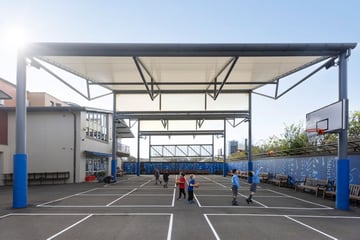
Consistent outdoor learning delivery needs infrastructure designed for year-round use. Without covered outdoor areas, schools default to exposed ovals or basic covered basketball courts that weren't specified for teaching delivery, which narrows the range of curriculum you can run outside and limits how reliably it gets scheduled.
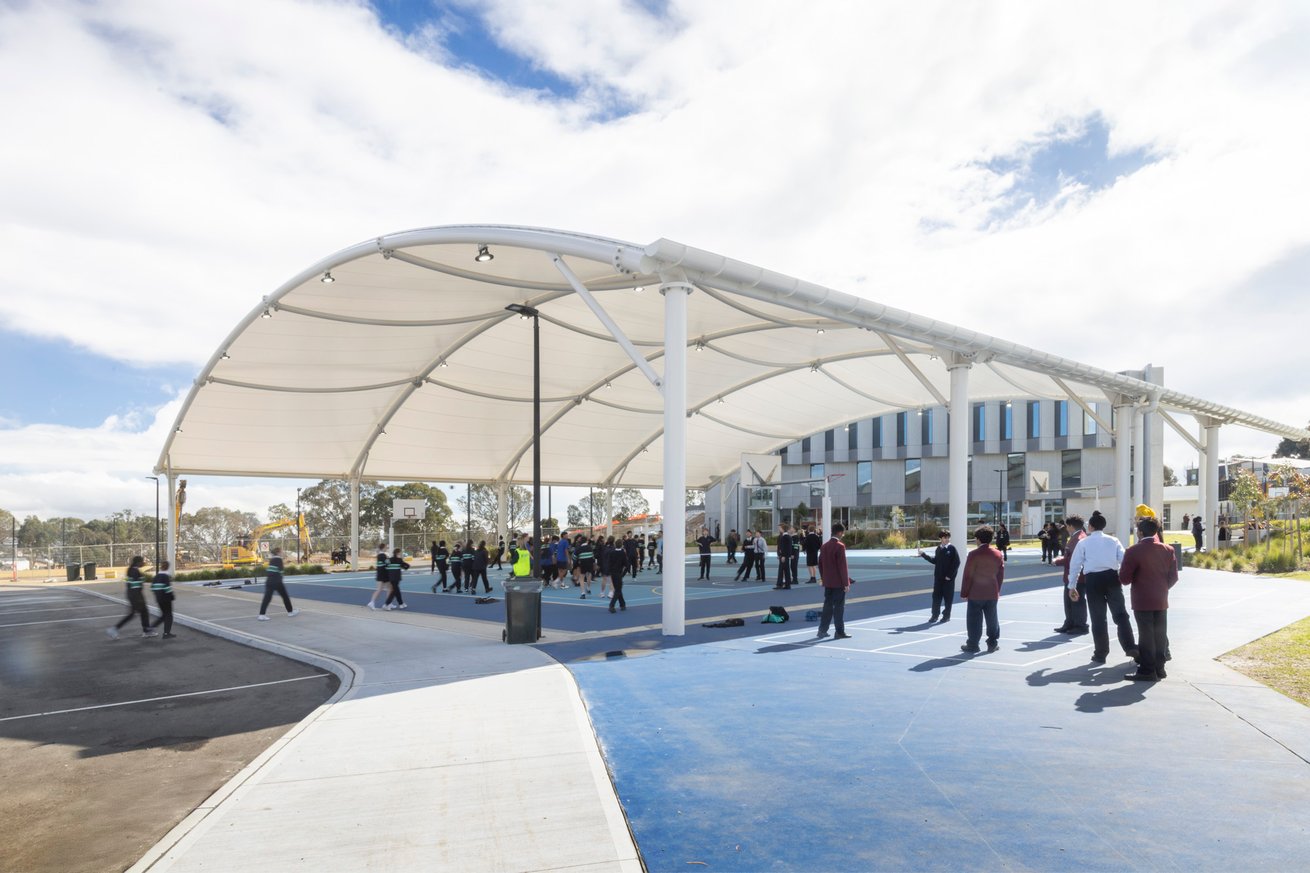
Covered outdoor learning areas make reliable delivery possible. Scheduled outdoor science lessons run regardless of weather. PE classes, outdoor literacy groups, and whole-school assemblies operate on schedule. The timetable stays intact.
Some schools deliver outdoor learning without purpose-built covered structures by timing lessons around peak UV periods, using existing shaded areas, or deploying portable shade. Infrastructure isn't a prerequisite for starting outdoor learning, but it's the enabler that makes it reliable and scalable across a full school timetable. Shade infrastructure also closes the UV compliance gap: AS 4174:2018 defines fabric UV protection ratings, and Cancer Council SunSmart accreditation requires schools to provide or work towards adequate shade. Whether you're considering fabric structures, steel roof structures, or shade sail applications, the goal is the same: outdoor space that works for students and teachers across every term of the year.
What covered outdoor infrastructure needs to deliver
If you're committing to outdoor learning as a curriculum priority, the infrastructure question comes down to what makes year-round delivery reliable and how the investment connects to measurable outcomes.
Covered spaces that preserve the outdoor feel
Well-designed covered outdoor structures keep the outdoor experience while providing weather protection. Quality architectural fabric membranes transmit roughly 9 to 25 percent of natural light across the roof plane, which filters daylight without UV exposure, and open sides keep airflow and environmental connection intact. The space reads as outdoor because it stays connected to the surrounding landscape, while delivering the protection teachers need to schedule reliably.
Good-quality shade can reduce UV exposure by up to 75 percent, which means students get the documented cognitive and physical benefits of outdoor environments while avoiding cumulative UV damage. A covered outdoor learning area delivers the outdoor benefits without weather-dependent scheduling disruptions or unmanaged UV exposure.
Multi-use design for learning, sport, and assembly
The strongest infrastructure investments serve several functions across the week. Morning PE. A Year 5 science lesson after recess. A whole-school assembly on Friday. Community use outside school hours. That multi-use approach delivers more value per square metre than a single-purpose facility and changes the math on the capital case.
It matters for timetabling too. Multi-use on-site facilities cut the cost and scheduling complexity of off-site sport and assembly bookings. Our outdoor sports facilities for schools are designed to accommodate multiple year groups, multiple sports, and multiple use types, which gives coordinators genuine flexibility without additional staff or external booking requirements.
Aligning infrastructure with curriculum goals
When you take an infrastructure proposal to a board, connecting the physical investment to measurable curriculum outcomes makes the case cleaner. More covered outdoor space means more scheduled outdoor learning hours actually running. Fewer weather cancellations mean teachers treat outdoor learning as a reliable delivery method rather than an optional extra. Better UV compliance means the school meets its duty of care and can demonstrate that to parents and regulators.
Framed this way, an outdoor learning area is an educational investment, not just a capital line item. For boards weighing capital priorities, a well-designed covered space solves multiple problems simultaneously: weather resilience, UV compliance, timetable flexibility, and multi-use capacity for sport, assembly, and community events. If budget is the constraint, our grant resources page lists current funding programs that can reduce the upfront gap and reviewing what's available early in planning gives you a clearer picture before you present to a board.
Staff confidence and rollout
Infrastructure solves the physical barrier. Teacher confidence decides whether the new covered space actually gets used for curriculum delivery. Supportive school leadership makes a significant difference to uptake; without it, even motivated teachers struggle to embed outdoor learning in their planning.
Schools that successfully bring outdoor learning into regular use typically start small. One or two willing teachers pilot outdoor lessons in a single subject, then expand across year levels, supported by practical professional learning and, in larger schools, an outdoor learning coordinator. Pair that with reliable covered space and outdoor learning moves from a good idea to a timetabled reality.
How we approach school outdoor learning projects
We are flexible but also aim to follow a structured approach. Our Consult. Design. Construct. methodology takes your project from concept through to handover with one team accountable throughout and a locked-in budget from the start. No handoff gaps between architect, engineer, and builder. One point of accountability across the project.
When we build on a live campus, we fabricate offsite and install onsite. That keeps the school operational through the construction window, with noise, dust, and contractor traffic on the ground compressed into a much shorter period. Business as usual for your staff and students while the structure goes up. Early engagement reduces risk, because the unknowns get resolved before the budget is locked rather than surfacing as variations after construction starts.
We start any conversation with how your school intends to use the outdoor space, which learning areas you want to support, and what your site and budget actually allow. From there, we handle design, engineering, approvals, and construction as a single coordinated team.
What we don't build
For the sake of clarity, we don't build demountables, modular buildings, small timber pavilions, or basic park shelters. If one of those is what your school actually needs, a different provider will be the right call. Our work sits in permanent, large-span, waterproof covered outdoor structures built for daily school use: sports courts, assembly spaces, multi-use covered outdoor learning areas, and architectural fabric and steel structures designed around how the space will actually be used across the school year.
Start with a conversation
If you're still in the early stages of thinking through what your school actually needs, our projects portfolio is the right place to start.
If you want a ballpark cost figure before committing to a detailed conversation, our Project Estimate Tool gives you a number in a few minutes.
And if you're ready to walk through your site, stakeholder priorities, and what a covered outdoor learning space would look like for your school, you can discuss your project with us and we'll cover site conditions, activity requirements, and budget in a single call.
Start with whichever fits. We're here when you need us.
Frequently asked questions
Our school is interested in SunSmart accreditation but doesn't yet have adequate shade in place. Does that disqualify us?
No. And this is a common misconception worth clearing up. Cancer Council's SunSmart Schools Programme recognises schools that are actively working towards adequate shade facilities, not only those that already have them in place. A school can achieve accreditation with a comprehensive sun-protection policy, strong UV scheduling, and a documented commitment to improving the physical environment over time. That means the compliance journey and the infrastructure journey can run in parallel. You do not need to wait until the structure is built to start pursuing accreditation.
What is the practical difference between a shade sail, a basic COLA, and a purpose-built covered outdoor learning area?
A shade sail provides UV protection but typically offers no weather protection, limited structural span, and no design flexibility for curriculum delivery. A basic COLA (covered outdoor learning area) adds a roof structure but may not account for orientation, airflow, acoustic performance, or the range of activities the space needs to support. A purpose-built covered outdoor learning area is designed around how the space will actually be used; what year groups, what subjects, what weather conditions, what supervision requirements.
The difference shows up immediately in how reliably the space gets scheduled and used, and over time in whether it earns its place on the timetable or gets managed around.
How do we build the case for outdoor learning infrastructure at a board or P&C level?
The strongest cases connect the physical investment to measurable curriculum outcomes rather than presenting it as a capital expense in isolation. More covered outdoor space means more scheduled outdoor learning hours actually running. Fewer weather cancellations mean teachers treat outdoor delivery as reliable rather than optional. Better UV compliance means the school meets its duty of care and can demonstrate that to parents and regulators. Framed this way, the infrastructure proposal answers several problems at once; weather resilience, SunSmart compliance, timetable flexibility, and multi-use capacity for PE, assembly, and community events, which tends to carry more weight with a board than a single-purpose justification.
Where do schools typically start when budget is a constraint but outdoor conditions need to improve?
Most schools begin by understanding what the site and the timetable actually require before committing to a scope or a budget figure. That early feasibility work clarifies what type of structure makes sense, where it should sit on the site, what activities it needs to support, and what a realistic cost range looks like, which is usually what a board or grants committee needs before they can say yes.
If you want to see how schools at different scales and budgets have approached this, the Greenline projects portfolio is a practical starting point.