
At some point in most architectural projects, the same pattern emerges. You begin with a clear intent: a space that responds to its context, supports how people move through it, and performs the way it needs to. And then, gradually, that intent gets adjusted. As structural logic begins to assert itself, budgets narrow the field, and buildability takes precedence.
The outcome still works, but it rarely carries the same clarity as the original idea.
And that process is so familiar it often goes unquestioned.
Tensile architecture shifts where that process starts. And when the starting point changes, the range of possible outcomes changes with it.
Rethinking structure from the start
At its core, tensile architecture resolves structure differently. Instead of relying on weight and rigidity, it works through tension, where membranes such as PTFE-coated glass fibre or high-tenacity PVC, combined with cables and supporting steel elements, stabilise each other through curvature and pre-stress.
Form emerges from that behaviour. It is not imposed afterwards.
This shift is more than technical; it changes how geometry, span, and enclosure are approached from the outset. Rather than working within a fixed structural grid or resolving loads through mass, you begin to shape a continuous surface that distributes forces across its entire form. Through this process, structure becomes responsive, able to adjust to orientation, context, and use in a way more rigid systems cannot.
This is why tensile systems have long been used where conventional approaches become inefficient. Stadium roofs, transport hubs, and civic structures rely on them to achieve large spans with clarity and without excess. What is changing now is not the capability of the system, but the scale at which it is being applied.
When the scale becomes relevant
Tensile architecture is still often associated with landmark buildings. Global projects reinforce that perception, and they are useful in demonstrating what is possible at scale. But the more meaningful shift is happening in projects much closer to everyday use.
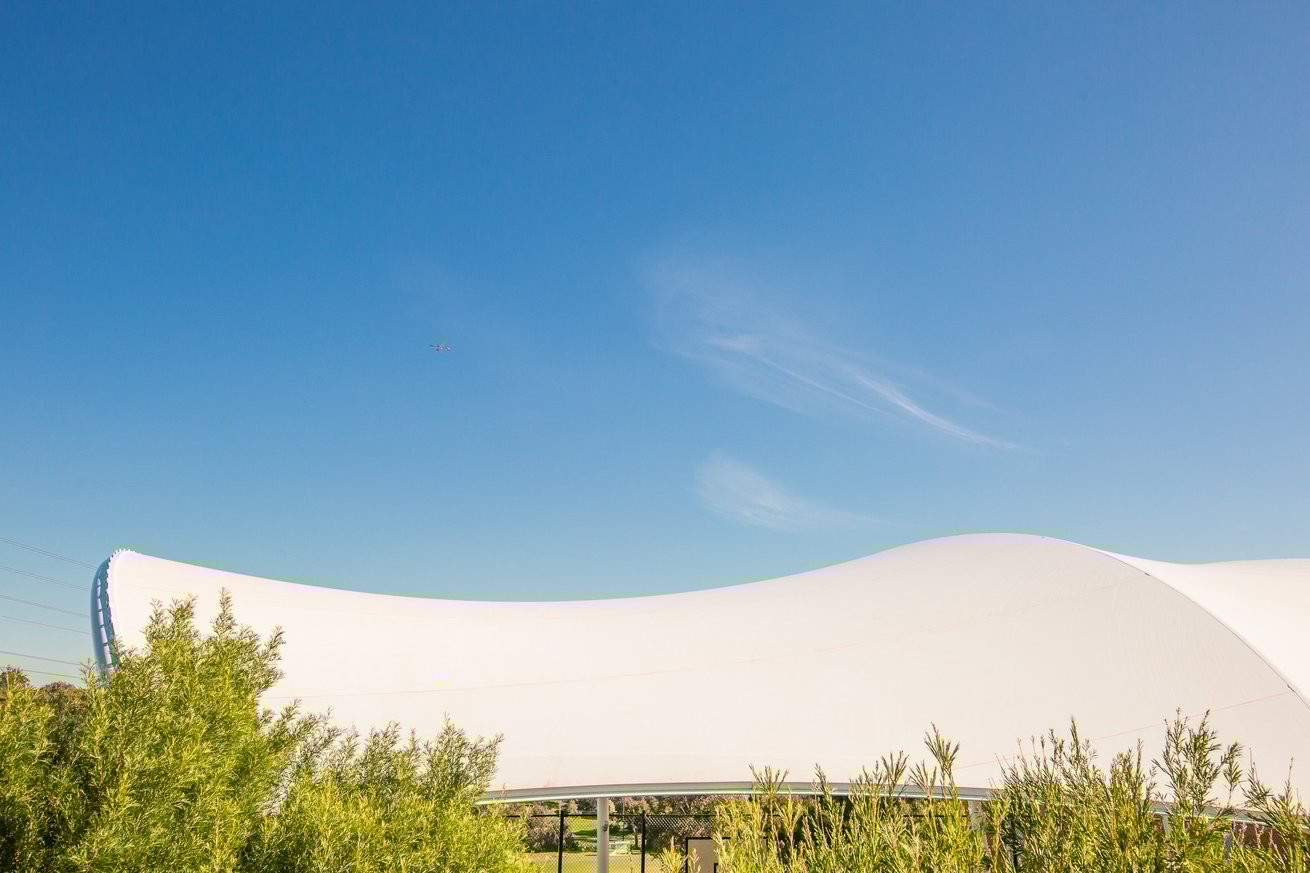
The Oriam indoor tennis centre in Edinburgh, Scotland, built by Spatial Structures, is a clear example. Six courts are covered within a single fabric structure, allowing the facility to operate consistently in a climate where outdoor play is unreliable. That alone addresses a practical need. What elevates the project is how the structure contributes to the experience of the space.
Externally, it carries a presence that feels deliberate rather than imposed. Internally, diffused daylight creates a more even visual environment, avoiding the glare typically associated with conventional rooflights. The structure is not working in the background. It defines both performance and identity at once.
Closer to home, Park Dome is another example. Built by Greenline, for Caulfield Park Sports Club, the fabric structure, and its tensile architecture, has evolved beyond infrastructure and into a landmark, and a brand in its own right. This is where a project, a structure, becomes a legacy.
And this is where tensile architecture becomes relevant beyond exceptional projects. It resolves real constraints while strengthening the architectural outcome. And the architectural design, the vision and the finished product now become part of the identity of the space, if not a component of the brand itself.
Designing with fewer constraints
In most projects, design develops through negotiation. Ideas are tested against structural systems, cost constraints, and construction realities, and the design adapts accordingly. With tensile systems, those parameters shift.
Large spans can be achieved with fewer internal supports, preserving sightlines and simplifying circulation. The structure can respond directly to movement and orientation, rather than conforming to a repetitive grid. Forms develop in response to the site, whether that leads to something expressive or more restrained.
The result is not an expansion of options for its own sake. It is a reduction in the compromises required to maintain a coherent design. Structure and intent begin to align more closely, and that alignment carries further through the life of the project.
This carries true value for architects who see fewer restrictions to their vision, especially if collaborating early with tensile structure experts to ensure buildability as the design takes shape and evolves.
Where performance shapes the outcome
A structure still has to perform, and this is where tensile architecture proves its value.
These systems provide reliable protection from sun and rain while maintaining openness. Natural light enters and is diffused across the surface, improving visibility without introducing harsh contrast or excessive heat gain. Airflow remains uninterrupted, helping regulate temperature and maintain comfort across changing conditions.
The impact is most evident in spaces that depend on consistent use. Schools, sports facilities, and civic environments all require reliability. When a space becomes unusable under certain conditions, it begins to lose relevance over time.
Stabilising those conditions changes how the space is used on a daily basis. Performance, in this context, becomes part of the design outcome rather than a secondary requirement.
Efficiency as a byproduct of the system
Because tensile structures are lightweight, they place less demand on supporting elements and foundations. Installation is typically faster, and material use is more efficient because the system works with applied forces rather than resisting them through mass.
These advantages are often framed in terms of cost, but they are better understood as efficiency. The value emerges in how the space performs over time. More consistent use, longer operating periods, and a closer alignment between design intent and actual use all contribute to a stronger return.
This shifts the conversation. The question becomes less about initial comparison and more about how effectively the structure supports the space throughout its lifespan.
Precision and rigour
Flexibility in form does not reduce the need for rigour. It places greater emphasis on resolving key decisions early.
Form, patterning, and tensioning all influence how the structure behaves over time, and those elements need to be aligned before construction begins. When they are, the system performs predictably. When they are not, issues tend to appear gradually and affect long-term performance.
This is why tensile architecture works best as an integrated process. Design, engineering, and construction are developed together, ensuring the structure performs as intended from the outset.
A proven approach, applied selectively
Across international projects, tensile systems are well established. In Australia, their use is increasing, particularly in response to the need for outdoor spaces that can withstand high UV exposure and heat while remaining comfortable and usable.
The opportunity lies in recognising where this approach can resolve those challenges more directly, without introducing unnecessary complexity or weight.
At Rhodes, a tensile structure was introduced into an existing civic environment to improve usability while maintaining alignment with the precinct’s architectural language. The intervention is modest in scale, but it allows the space to function more consistently throughout the year while blending in with the current aesthetics of the space, and elevating it.
Projects like this demonstrate how the same principles seen in larger international work can be applied with precision at a local level.
Carrying intent through to delivery
The challenge in most projects is not so much about defining intent, but maintaining it through the process that follows. Tensile architecture provides a way to carry more of that intent forward. Structure aligns with performance, and that alignment reduces the need for compromise as the design develops.
Over time, the difference is not found in the novelty of the system, but in the clarity of the outcome. And that's where the whole process started, with clear scope and expectations of outcomes. If you're working on a project where the structure should do more than hold things up - where form, performance, and intent need to stay aligned - we'd like to hear about it. Let's talk now.