Schools searching for the "best" outdoor classroom structure are rarely asking for the most expensive option, the most complex build, or the most impressive design.
They're really asking:
- What works best for our students?
- What will actually get used?
- What won't create problems down the track?
There's no single "best" outdoor classroom structure. There's only the best fit for how your school plans to use the space.
If you're reading this, you're already asking the right question. Many schools get this wrong by choosing based on appearance or price alone, without considering how the space will perform across different weather conditions, teaching formats, and years of use.
We are often engaged before a school commits to a structure, or after a structure has underperformed. That means we see what works long-term and what doesn't. We've learned to recognise the patterns, and we've developed a clear view of where each type of structure fits.
What schools are really trying to achieve
Before comparing structure types, it's worth understanding what drives these projects in the first place.
Most schools need outdoor learning spaces for one or more of these reasons:
1. Expanding teaching capacity without building new classrooms.
When enrollments grow and indoor space is limited, outdoor learning areas provide flexible teaching capacity. They accommodate small groups, whole classes, or year-level assemblies, all without the cost and time of traditional building projects.
2. Creating multi-purpose spaces that work hard all day.
The most valuable outdoor spaces serve more than one function. They support formal learning in the morning, PE classes at midday, assemblies in the afternoon, and community events after hours. They become active campus assets, not decorative additions.
3. Reducing timetable uncertainty caused by weather.
Schools in Sydney average 122 days of rain per year. That's a third of the year when shade-only structures can't support learning. If outdoor space can't be relied on, teachers stop planning around it. Weather protection turns an optional space into a dependable one.
4. Supporting different types of learning.
Outdoor classrooms aren't just for fine days. They enable collaboration, hands-on work, cultural activities like yarning circles, and movement-based learning that doesn't fit inside four walls. The space needs to support how teachers actually teach, not just provide shelter.
5. Creating long-term campus value, not short-term fixes.
Capital projects are judged on decades, not years. A structure that serves the school reliably for 25 years costs less per year than one that underperforms or needs early replacement. Longevity matters, both financially and operationally.
The structure that delivers on these outcomes is the one that gets used.
What actually makes an outdoor classroom "best"?
Once you understand what the space needs to achieve, you can define what makes it work.
Usability matters more than appearance. The best outdoor classroom is one that teachers want to use. If it's too hot, too loud, or too exposed, it will sit empty.
Weather reliability determines how often the space can be timetabled. A shade sail is excellent for fine days. A waterproof structure allows learning to continue when the weather turns.
Flexibility affects how many uses the space can support. Can it accommodate assemblies? Group work? PE classes? The more functions the space can serve, the more value it delivers.
Comfort is often underestimated. Natural light, temperature management, acoustics, and airflow all affect how students learn and how long they can stay focused.
Longevity separates short-term savings from long-term value. A structure that performs reliably for 25 years costs less per year than one that needs replacement after 10.
Timetable certainty is what this all adds up to. If staff can rely on the space being available, they'll build it into their programs. If they can't, it becomes an afterthought.
Matching structure types to how schools use space
This isn't a ranking. It's a guide to understanding which structures support which outcomes.
|
Use Case |
Structure Type |
Why Schools Choose Them |
Limitations to Understand |
Best Fit If… |
|
Shade and informal learning |
• Fast installation• Lower upfront cost• Effective UV protection for fine-weather use |
• Not weatherproof• Limited use in rain or strong winds• Not suitable for timetable-critical spaces |
Sun protection is the main requirement and outdoor learning is an occasional addition, not a core part of your timetable |
|
|
Year-round outdoor learning |
• Fully waterproof and 100% UV protected• Large clear spans without internal columns• Excellent natural light (typically 9–25% transmission)• Brighter and more comfortable than steel roofing |
• Higher upfront planning and investment• Requires good design to manage acoustics and airflow |
Outdoor learning is a core part of your program and timetable certainty matters |
|
|
Permanent, high-use outdoor classrooms |
• Long design life (typically 50+ years for the frame)• Fully weatherproof• Strong sense of permanence and investment |
• Heavier visual impact if poorly designed• Heat and acoustics require careful treatment• Darker underneath than fabric options |
The space is a long-term campus asset with constant use and a considered design process |
|
|
Multi-purpose school spaces |
• Support learning, sport, assemblies, and community use• Maximise return on space• Improve timetable certainty across departments |
• Require upfront planning and stakeholder alignment• Design must balance competing uses |
The space needs to work hard all day, all year, across multiple activities |
Note on covered outdoor learning areas (COLAs): A COLA isn't a structure type — it's how the space is used. If your covered outdoor space supports learning, sport, assemblies, and community use, we typically refer to it as a COLA.
When outdoor learning is occasional, not core
Some schools need simple sun protection for informal learning, small group work, or break-time shade. Outdoor learning is supplementary rather than essential. In these cases, shade-focused solutions make sense.
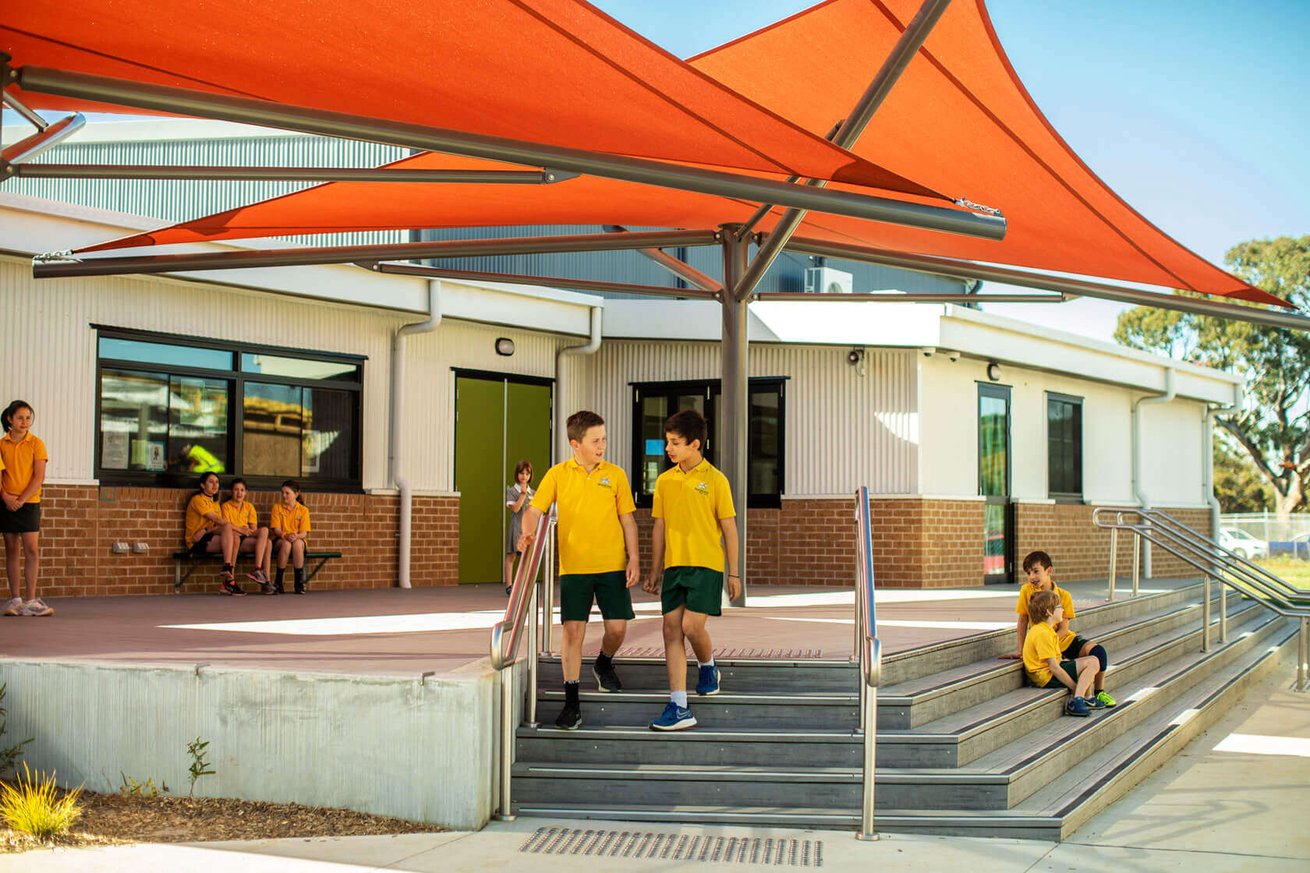
Shade sails are fabric structures, tensioned membranes stretched between posts or attachment points. They range from basic installations to more engineered systems with steel frames, but they're all primarily designed for sun protection rather than full weather coverage. They work well when sun protection is the primary goal and weather-dependent scheduling is acceptable.
Why schools choose them:
- Fast installation
- Lower upfront cost
- Effective UV protection for fine-weather use
- Good airflow and lighter visual impact
Limitations to understand:
- Not weatherproof
- Limited use in rain or strong winds
- Best suited to informal or occasional learning
These options work when scheduling can flex around the weather. If outdoor learning is an occasional addition to your program, they're worth considering.
When outdoor learning is a core part of the program
Schools that embed outdoor learning into their timetable need structures they can rely on, regardless of weather. This is where waterproof, engineered structures become essential.
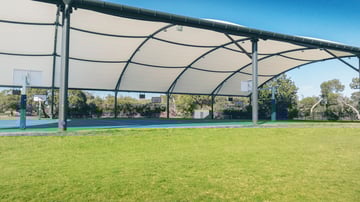
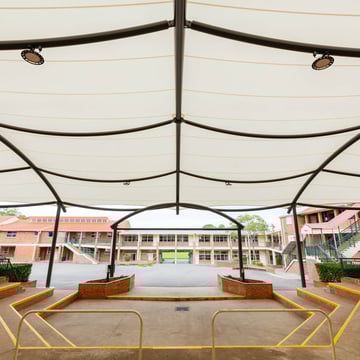
Waterproof fabric structures include (but aren't limited to) barrel vaults, cantilevers, hip structures, and conical structures. These provide full weather protection: UV, rain, and in many cases, wind. They're engineered for commercial applications and designed for consistent, year-round use, owing to materials PVC, HDPE, and PTFE.
These structures provide 100% UV protection and are fully waterproof. They allow excellent natural light transmission, typically between 9-25%, creating bright, comfortable learning environments. Fabric roofing is brighter underneath than steel, which enhances both aesthetics and comfort for students and staff.
Why schools choose them:
- Waterproof and UV protected
- Large clear spans without internal columns
- Excellent natural light
- Suitable for outdoor classrooms, COLAs, and multi-use spaces
Limitations to understand:
- Higher upfront planning and investment
- Requires good design to manage acoustics and airflow
If timetable certainty matters and outdoor learning is not an add-on, this is usually the right category.
When the space is a long-term campus asset
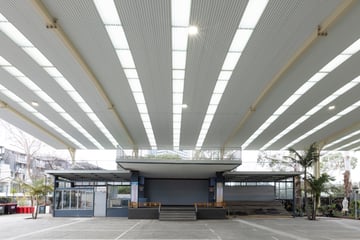
Steel roof structures offer a permanent, hard-roofed solution. They provide full weather protection with excellent longevity. When designed well, they can serve as long-term campus assets. They require careful attention to acoustics, heat management, and visual integration.
Why schools choose them:
- Long design life, typically 50 years for the frame
- Fully weatherproof
- Strong sense of permanence and investment
Limitations to understand:
- Heavier visual impact if the design is not carefully considered
- Heat and acoustics require specific attention
- May feel darker underneath compared to fabric solutions
Steel structures work best when the space is in constant use, the school has a long-term design process in place, and visual integration with existing buildings is part of the planning.
When the space needs to serve multiple functions: covered outdoor learning areas
Some schools need outdoor spaces that do more than one thing. Learning in the morning, PE at midday, assemblies in the afternoon, community events after hours. COLAs are typically built using waterproof fabric structures or steel roof structures.
Why schools create COLAs:
- Support learning, sport, assemblies, and community use
- Maximise return on space
- Improve timetable certainty across multiple departments
What this requires:
- Upfront planning and stakeholder alignment
- Design that balances competing uses
- Weatherproof protection so the space can be relied on
If your outdoor space needs to work hard all day, all year, across multiple activities, you're planning a COLA. The question then becomes: fabric or steel? That depends on your priorities around natural light, longevity, acoustics, and budget.
What influences the cost of outdoor classroom structures?
Cost depends on more than just the structure type.
Size and span are obvious factors. Larger structures cost more, and clear spans — meaning fewer internal columns — require more engineering.
The level of weather protection affects materials and design. Shade-only structures cost less than fully waterproof solutions.
Engineering requirements vary by site. Wind exposure, soil conditions, and local regulations all influence what's needed.
Site conditions include access, slope, existing services, and any ground contamination. Difficult sites add cost and time.
Permanence and materials affect both upfront cost and long-term value. A 50-year design life costs more initially but less per year over time.
Acoustic and lighting considerations matter for learning spaces. Getting these right requires design input early in the process.
The cheapest structure upfront is not always the lowest-cost option over time. A structure that can't be used reliably, or that needs early replacement, ends up costing more than a well-planned solution that performs year after year.
Want to understand what your project might cost? Try the Project Estimate Tool to get a preliminary cost range.
Common problems schools face, and how to avoid them
Outdoor classroom projects go wrong in predictable ways. Understanding these patterns helps you avoid them.
Choosing a structure that looks good but doesn't get used.
This happens when design focuses on appearance rather than use. A beautiful structure that's too hot, too loud, or too exposed won't support learning.
Underestimating weather exposure.
Schools often underestimate how frequently rain, wind, or heat will affect usability. If you're in Sydney, for example, you're looking at an average of 122 days of rain per year. That's a third of the year when a shade-only structure won't serve your timetable.
Poor acoustic performance.
Hard surfaces and open spans can create echo and noise problems. This is especially common with steel structures that haven't been designed with acoustics in mind.
Designing for today, not future enrolments.
Schools grow. A structure that meets current needs but can't accommodate future capacity becomes a constraint rather than an asset.
Treating the structure as a product instead of a learning space.
The best outcomes come from thinking about how the space will be used, then designing a structure to support that use. Starting with a structure type and hoping it fits your needs rarely works as well.
Consider more than the structure
Sometimes the right decision isn't just about structure type.
Budget cycles affect timing. A staged approach might deliver better outcomes than a single compromised project.
Master planning matters. If your school is in the middle of broader campus planning, the outdoor classroom should fit within that vision.
Approvals take time. Council requirements, heritage considerations, and stakeholder sign-off can all influence what's possible.
Site constraints shape design. Access, services, slope, and existing features all affect what works.
Staged development can make sense. Starting with a structure that supports current needs, with the ability to extend later, is sometimes the smartest path forward.
Sometimes the best decision is the one that supports the next 10 years, not just this year.
Looking for funding support? Explore available grants for schools to help fund your outdoor learning project.
The "best outdoor classroom" is the one that gets used
The best outdoor classroom structure is the one that supports your students, fits your teaching approach, and serves your school's long-term plans.
It's the one that teachers want to use. The one that works reliably, whatever the weather. The one that becomes part of how your school operates, not a feature that gets forgotten.
The best structure isn't the most impressive one. It's the one that supports learning, reliably, year after year.
If you're exploring outdoor classrooms and want a second opinion, we're happy to help.
Discuss your project with a Greenline expert to understand what structure fits your school's plans.
Want to get a sense of costs before you speak to anyone? Use our Project Estimate Tool for a preliminary budget range.
Or, if you'd like to understand how we work, learn more about our Consult Design Construct methodology and how it ensures your project is delivered on time and within budget.
We've been helping Australian schools create functional outdoor learning spaces for over 25 years. Whatever stage you're at, we're here to help you find the right solution.