
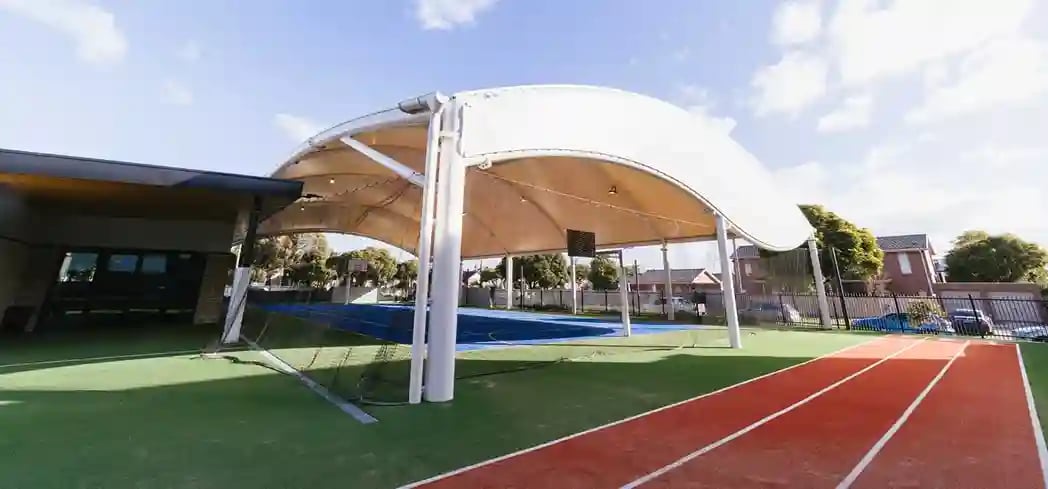
Is your school’s outdoor space inviting students to connect, or forcing them back inside? If a campus lacks adequate shelter, courtyards and lawns that should be brimming with activity become "no-go zones" during extreme heat or wet weather.
With the right infrastructure, these spaces can bridge the gap between the classroom and the outdoors, offering fresh air and opportunities to connect with peers irrespective of what the weather’s doing.
In this article, we explore how schools and universities can reimagine their outdoor architecture. We’ll cover actionable design strategies, the benefits of covered spaces, and real-world examples of campuses that have successfully unlocked their full potential.
Shade systems and formats
Creating shaded areas is easy. The hard part is ensuring the infrastructure keeps doing what it is supposed to do without unforeseen dips in performance. This requires a mix of three fundamentals working in tandem:
- Equipment quality: Material selection, fit, and finish.
- Engineering precision: How well the installation handles real-world stresses, including footing design, wind load projections, and water management.
- Design ingenuity: Smart implementation that maximises value. This includes sun path assessments to optimise coverage, minimising raw material use, modularity, and integrated utilities.
The most successful projects emerge as design teams are given the creative license to innovate.
Below are several shade options and formats adaptable to different zones of your campus, balancing ingenuity with your specific budget and stakeholder requirements.
Tensioned fabric canopies
Tensioned fabric canopies generally fall into two groups: shade sails and tensile membrane structures. Both rely on fabric held in tension, but they behave differently once scaled, engineered, and embedded into a campus.
Shade sails use UV-rated commercial mesh or PVC fabrics stretched between engineered posts and other anchor points. They tend to suit smaller or more informal spaces such as playgrounds, seating courtyards, and walkways.
Their appeal lies in flexibility. They can be shaped, coloured, and arranged to suit irregular footprints, and multiple sails can be combined to define space or introduce visual interest without making the area feel enclosed.
Tensile membrane systems are more complex, as they use high-span PVC or PTFE fabrics tensioned in incredibly creative ways. They’re used where coverage needs to be predictable and continuous.
These are often used for sports courts, assembly areas, and outdoor learning zones where rain protection matters as much as shade. The structure carries larger spans, tighter tolerances, and greater responsibility for drainage, which is why form becomes critical at the design stage.
A prime example of this technology in action is our work at St Bernard’s College in Essendon.
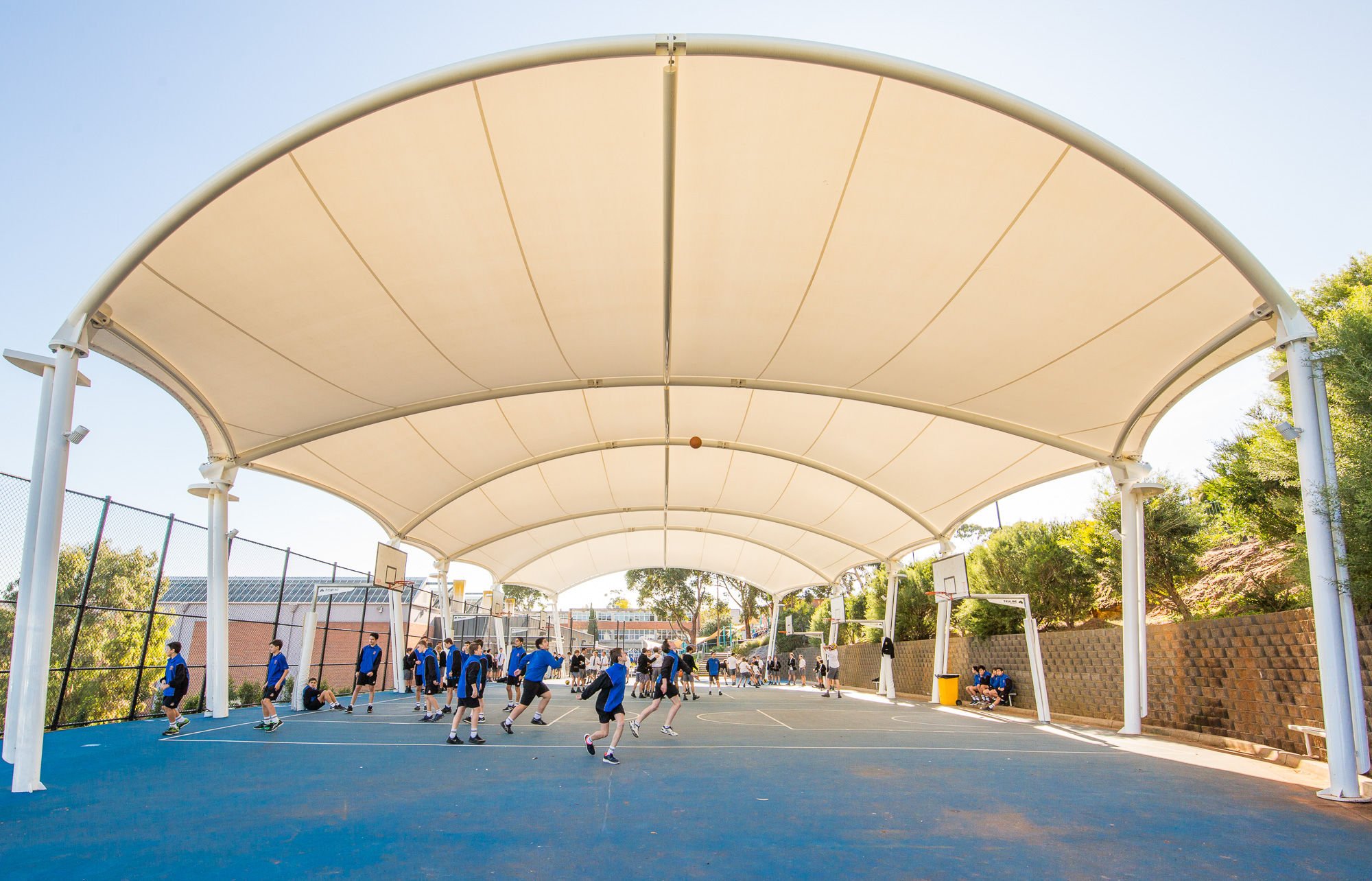
In collaboration with Smith+Tracey Architects, our team developed a custom tensioned PVC canopy for the college’s outdoor basketball court. Spanning approximately 20m x 38m, the structure uses white Mehler PVC to provide 100% UV blockage and full waterproof protection.
Beyond its utility, the project is a masterclass in sculptural expression. By using angled posts, canted rafters, and catenary fabric edges with integrated rainwater management, the design achieves a "floating roof" effect with no right-angle joins.
Visible from passing traffic, the court canopy, beyond serving functional needs, also elevates the campus streetscape with an interesting architectural presence.
While these canopies appear lightweight and vibrant, they are engineered with robust steel supports and high UV-rated materials to ensure they block the majority of sunlight during peak hours while maintaining a lively, lit-up, inviting atmosphere.
Barrel vaults
Barrel vaults are highly efficient structural forms, utilizing a curved, semi-cylindrical profile to provide expansive clear-span coverage without the need for internal support columns. These systems are particularly effective for large-scale sports facilities and outdoor learning hubs, where the arched design naturally facilitates superior water runoff and creates a high-clearance, airy environment.
A standout application of this format is at Waverley College, where we delivered a striking PVC membrane barrel vault over the rooftop basketball court of the Cosgrove Centre.
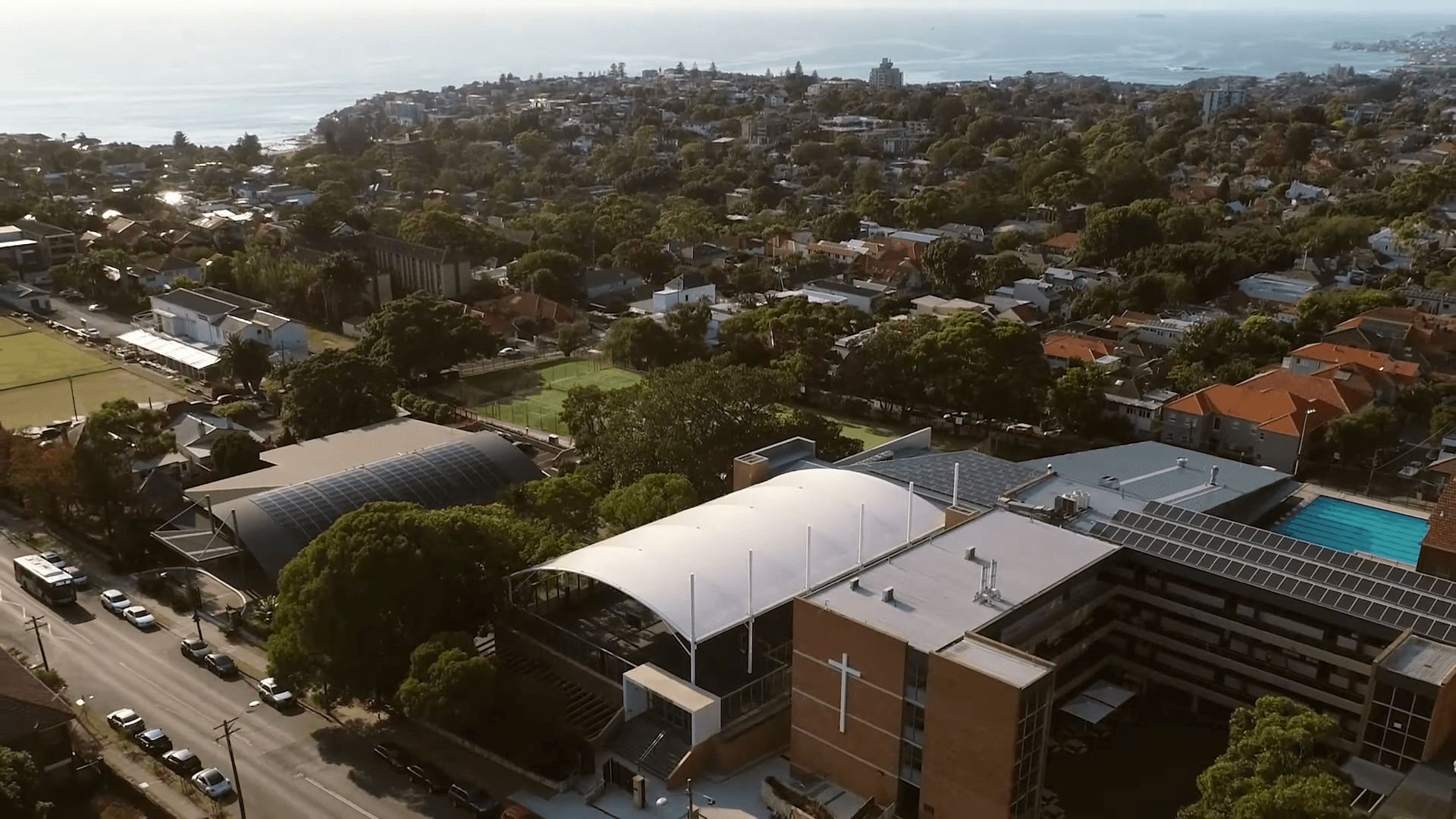
Measuring approximately 23.5m x 36m, the permanent structure uses white Ferrari 802S PVC fabric with a 9% light transmission rating; this allows for a bright, natural outdoor feel while ensuring students and staff remain protected from both rain and harsh UV exposure.
Because the court is situated directly above an existing gymnasium and adjacent to a busy main road, the project required tremendous logistical coordination. Our team implemented structural strategies to minimise rooftop load and managed access constraints during installation.
The result enabled the school to effectively double its usable PDHPE (Personal Development, Health and Physical Education) space, demonstrating how customised barrel vault solutions can maximise the utility of constrained urban sites and turn under-utilised rooftops, and spaces, into premium all-weather facilities.
Cantilever structures
Cantilever structures offer a unique solution for areas where space is at a premium or where vertical obstructions must be avoided at all costs. By utilising a support system anchored at only one side, these structures allow the roof to project outward over the desired area, leaving the ground plane entirely clear of columns.
This makes them particularly well-suited for spectator seating, narrow walkways, and bus pickup zones where unimpeded movement and clear lines of sight are essential for safety and flow.
Because they rely on a single-sided foundation, cantilevers require rigorous engineering to manage the significant leverage and wind loads placed on the footings.
Hip structures
Tensile membrane hip structures are a tensioned fabric format modelled after the traditional hip-roof form, featuring a central high point with fabric sloping down to lower perimeter corners. This geometry is exceptionally efficient at shedding water and managing wind loads, making it one of the most stable formats for large, open squares.
A successful application of this design can be seen at Aquinas Catholic College, where we replaced an underperforming shade system with a PVC hip canopy.

Spanning approximately 22m x 22m over a central courtyard, the structure utilises a Mehler FR900-N PVC membrane supported by six posts finished in Colorbond Surfmist.
This specific material choice keeps the multi-use area light and bright while delivering 100% UV blockage and total waterproof protection. What makes this installation particularly effective for a school environment is the use of catenary edges.
By using these curved fabric boundaries, the design naturally directs water runoff without the need for gutters or complex stormwater plumbing, significantly reducing long-term maintenance requirements.
Star structures
Star structures, often referred to as "Star-sails" or umbrellas, are centered around a single, robust structural mast with radiating arms that tension the fabric into a wide, symmetrical canopy. This format is ideal for social hubs and smaller focal points, as it provides a large area of coverage with a minimal ground footprint, allowing for unobstructed movement around the base.
At Bundoora Primary School, this format provided a practical solution for a canteen and adjoining decking area that was previously too exposed for comfortable use. Our team installed two free-standing 8 m x 8 m star structures, creating a contemporary look that feels more like an architectural statement piece than a standard shade structure.
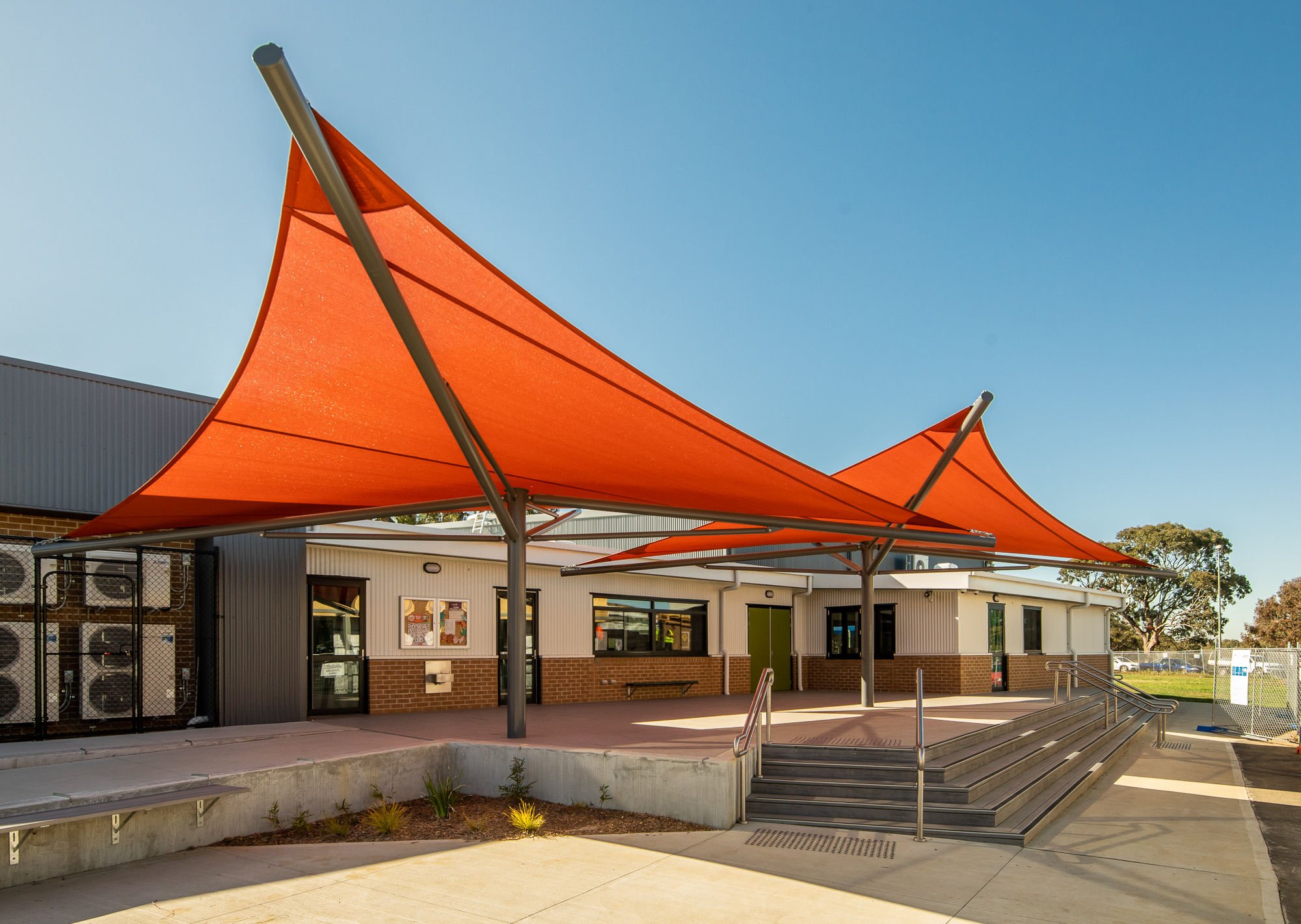
A standout aspect of this project was the specialised installation required to navigate on-site constraints; because underground services ran directly through the zone. We used hydro-vacuum excavation to safely place the footings without utility disruption.
To ensure a cohesive finish, the steelwork was colour-matched to the existing decking in a dark basalt tone, while the Cayenne-coloured commercial shade mesh defines the space and provides high-level UV protection. This project highlights how visually interesting shade forms can be successfully integrated into tighter campus footprints, even when navigating complex subterranean infrastructure.
Pergolas with climbing plants
Another option to consider, especially in courtyards and along circulation paths, is the use of traditional pergolas. These structures, built from timber or metal, provide a framework that can support climbing plants such as vines or wisteria.
Over time, the foliage creates a natural, evolving shade layer that softens hard surfaces and supports a more comfortable outdoor microclimate without the need for complex engineering. While plant-based shade takes time to mature, it blends built and natural elements in a way many campuses find appealing.
Slatted roof panels
For schools seeking a blend of architectural style and climate control, shade pergola roof panels offer a sophisticated, adjustable alternative.
Unlike fixed urban shade structures, these pergolas feature slatted or louvered roof systems that can be tuned to specific sun angles, allowing schools to dictate exactly how much light or airflow enters a space throughout the day.
This level of adaptability makes them an ideal suggestion for outdoor study zones and transitional spaces where glare control is essential for laptop use and reading. To wrap up the technical overview, it’s worth considering how these formats translate into actual applications.
Rigid roofed shelters & pavilions
Rigid-roofed shelters and pavilions represent the most robust tier of outdoor infrastructure, utilising traditional building materials like steel, timber, and metal decking to create permanent, low-maintenance environments.
Unlike fabric systems, these solid-roof structures offer complete acoustic insulation and total weather exclusion, making them an ideal choice for high-traffic zones that require the same level of reliability as an indoor facility.
A primary example of this scale and durability is found at Castle Hill High School, which required a permanent solution to ensure their outdoor sports courts remained functional in all conditions.
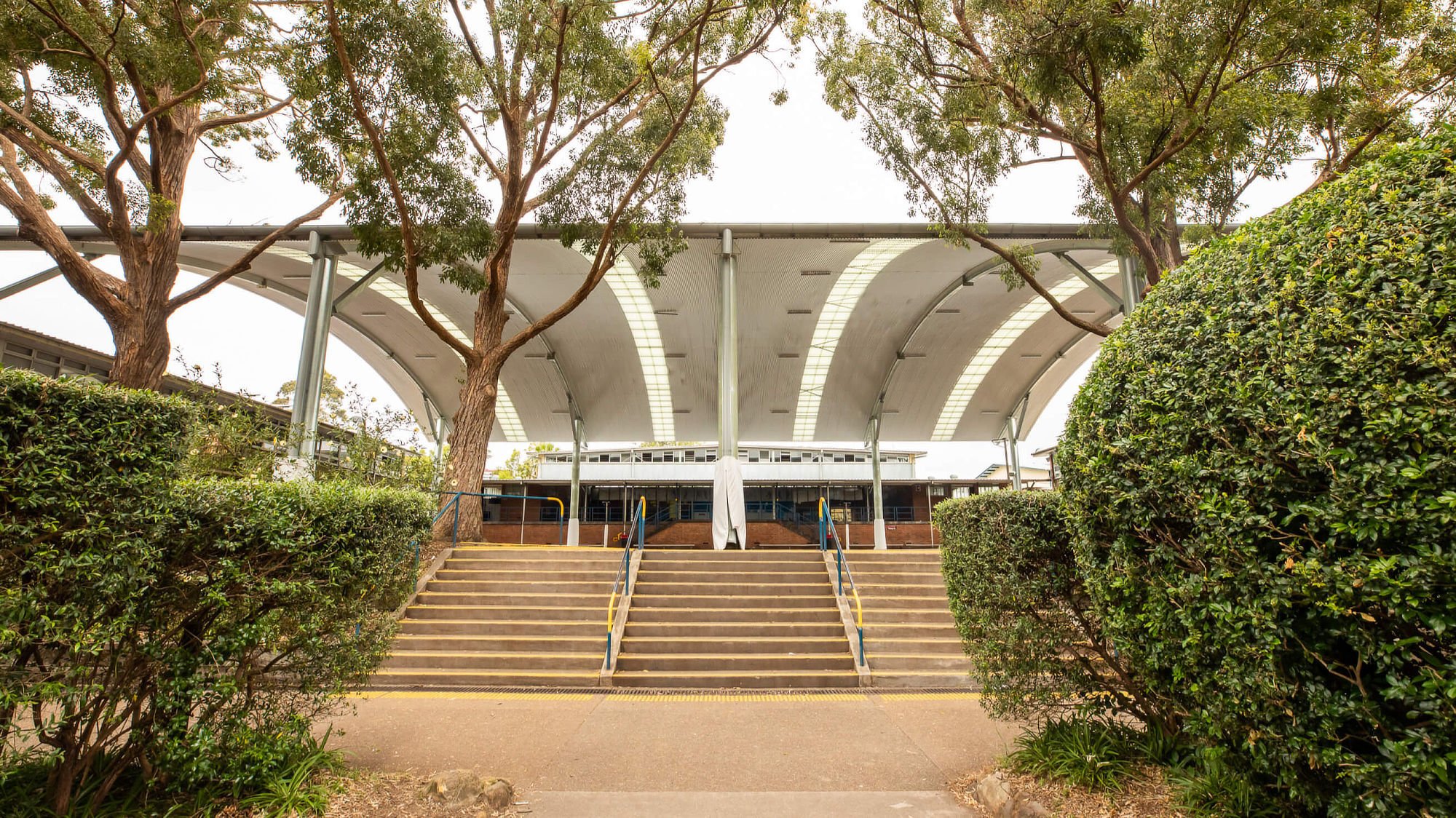
We delivered a 31.5m x 42.6m curved metal roof Covered Outdoor Learning Area (COLA) that spans two full-sized basketball courts.
The structure features hot-dip galvanized steel framing and a soffit-lined curved roof, designed to blend seamlessly with the existing campus architecture while providing dependable, year-round protection. To address the specific environmental needs of the site, we integrated several specialized design features.
Bird proofing was installed to minimise maintenance within the school’s leafy setting, while opal glass skylights were embedded into the roof to ensure the courts remain brightly lit by natural light during the day.
Beyond providing shade and rain cover, the project has fundamentally expanded the school’s operational capacity; the space now serves as a versatile outdoor hall for full school assemblies, community events, and sporting competitions that were previously impossible to host on-site.
Campus and activity-based shade applications
The true value of a covered space is measured by its "usability multiplier", that is, how many additional hours it allows students to remain outdoors regardless of the forecast.
For schools, this infrastructure translates to fewer cancelled PE classes, more flexible teaching environments, and safer recreation zones that meet modern UV-safety standards. Across major Australian campuses, several core design principles are now driving these applications:
- Visibility and access: Strategic placement along "desire lines" (the natural paths students take between buildings).
- Programme mix: The most successful shade projects are those that integrate multiple functions, such as social hubs that double as outdoor dining or event spaces.
- Climate control and comfort: Beyond simple coverage, integrating seating variety and climate-responsive design directly enables year-round campus life.
- Adjacency and capacity: High-performing institutions are pairing indoor study lounges with covered outdoor extensions, effectively broadening the building’s capacity without the cost of a full internal expansion.
- Identity and inclusion: Modern masterplans, such as the University of Queensland’s Informal Learning Space Design Guide, emphasise incorporating First Nations design narratives into shade infrastructure.
Here are some ways in which these designs play out as actual applications for shade infrastructure across the modern educational environment.
Covered entryways
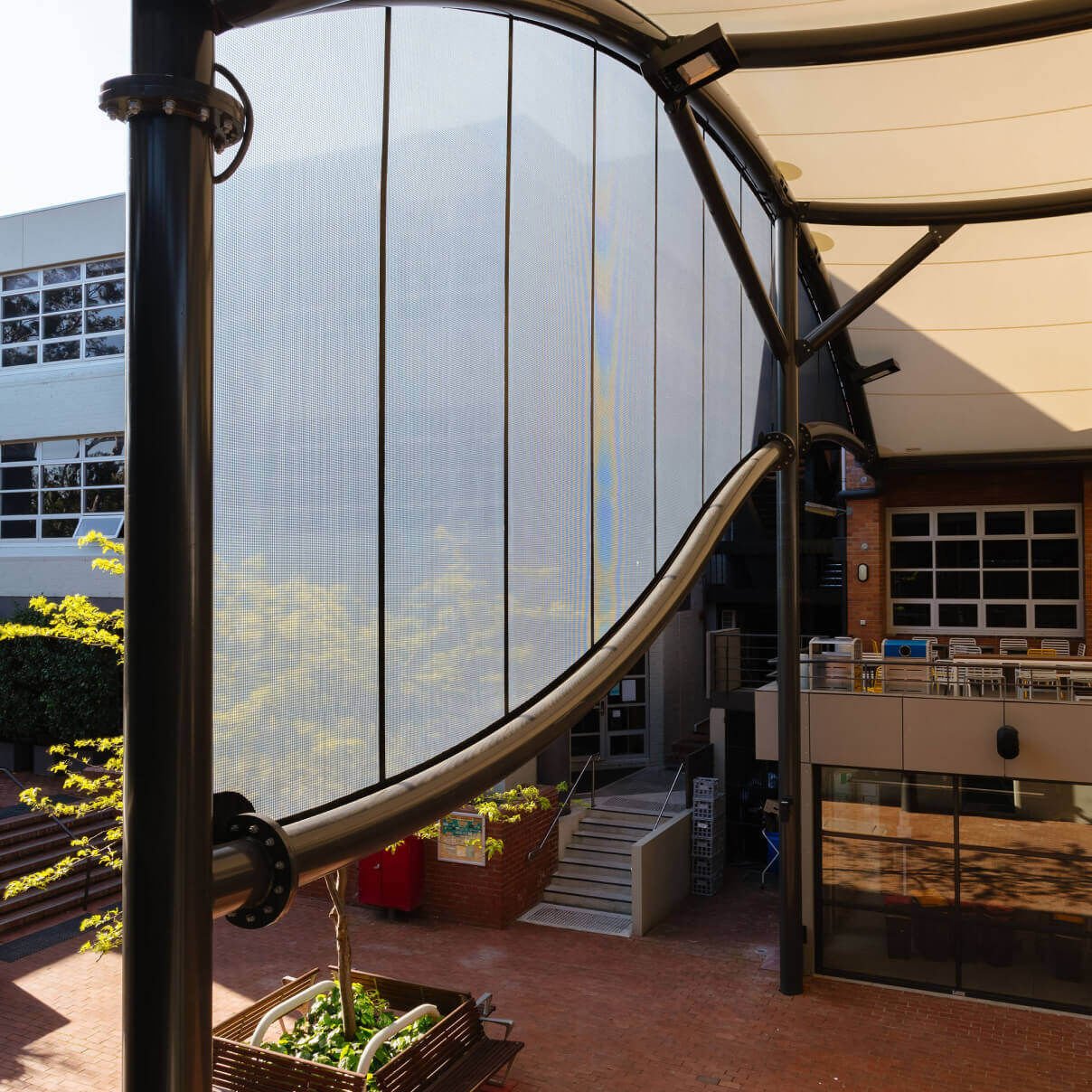
Every school has a primary point of arrival that shapes the immediate perception of the campus. Whether it is a main gate, a central forecourt, or the approach to an administration building, that first interaction sets the tone for the entire visitor and student experience.
Architectural shade structures serve as a powerful tool to elevate these spaces. These signature structures signal a commitment to investment, safety, and campus pride, framing the educational experience before a student even enters a building.
As with all high-caliber design, these solutions are most effective when form follows function, ensuring the structure feels like a natural, integrated extension of the campus rather than a secondary addition.
An example of this approach is our work at Galen Catholic College in Wangaratta. Here, we delivered a coordinated suite of permanent shade structures spanning 1,779 m2 to unify a sprawling campus.
The project leveraged a mix of formats (including a PVC barrel vault, custom cantilevered walkways, and shade sails) to protect administration entries, multi-purpose sports courts, and the primary thoroughfares between buildings.
The success of the Galen project lies in the integration of multiple shade types into a single functional system. For student pick-up zones, cantilevered shelters provide protected waiting areas that don't obstruct the sidewalk, while expansive shade sails create flexible zones for spectator seating and outdoor lessons.
Walkways and drop-off zones
Movement between buildings defines the rhythm of the school day. Without adequate protection, simple transitions can become a logistical challenge; heavy rain or extreme heat forces students and staff to rush, creating bottlenecks and discomfort.
Covered walkways solve this by providing weather-safe "arteries" that link classrooms, libraries, and social hubs, making the campus feel like a singular, integrated environment rather than a collection of disconnected buildings.
Beyond weather protection, these covered connections serve several critical operational roles. They improve line-of-sight for staff supervision, support universal accessibility for users with mobility needs, and create organised, safer arrival and pick-up zones.
Parking lots and micro-mobility hubs
Parking areas, drop-off zones, and micro-mobility hubs are among the most consistently used parts of a campus, yet they are often the least protected from sun and heat.
When these areas are shaded, they become more reliable transition points that reduce heat exposure.
On larger university campuses, shaded car parks and end-of-trip facilities are increasingly being planned as part of the broader public realm, supporting cycling, scooters, and pedestrian movement rather than functioning as isolated infrastructure.
In some cases, canopy systems are also used to organise circulation more clearly, improving wayfinding and reducing congestion around building entries.
Sports courts and spectator areas
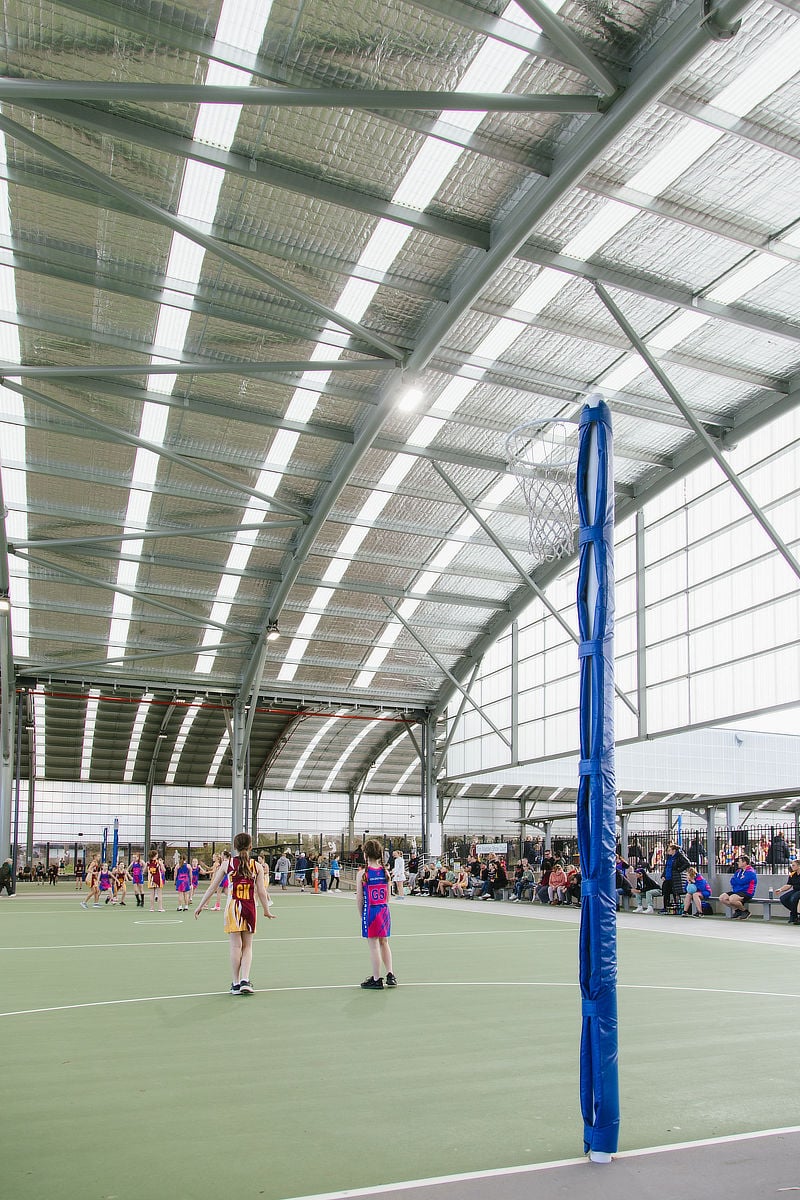
Sports courts are one of the clearest examples of how shade directly increases usable hours. Covered courts allow physical education classes, training sessions, and informal play to continue through heat and light rain, improving timetable certainty and reducing cancellations.
Shade over adjacent spectator areas also changes how these spaces are used, encouraging staff, students, and visitors to remain longer and engage with school sport outside formal competition times. They also ensure a better degree of safety and compliance for all (in line with the SunSmart guidance, echoed by education departments).
For many institutions, the case for covering courts is as much operational as it is experiential, with shade infrastructure supporting safer conditions, more predictable scheduling, and higher utilisation of existing facilities across the year.
Measurable benefits
Once shade becomes part of everyday campus use, its impact shows up in places that are easy to overlook at first. Movement slows where people are comfortable to stay. Informal spaces stop being pass-through zones and start holding activity for longer stretches of the day.
What follows are the outcomes institutions tend to see once outdoor areas are consistently usable, based on observed campus behaviour, planning guidance, and built examples rather than theory alone.
Tangible value to institutions
Beyond student wellbeing, investing in high-quality shade infrastructure provides significant financial and operational advantages for educational institutions.
One of the most direct benefits is the reduction of attrition costs; as student retention is inextricably linked to campus satisfaction and mental health, the gains made in wellbeing through improved social hubs translate into a more stable student body.
Additionally, flexible, all-weather outdoor spaces improve capacity, effectively extending a school's usable teaching and recreation footprint. This allows institutions to accommodate larger cohorts and more diverse programming without the massive capital expenditure.
Shade infrastructure also transforms a campus into a community asset capable of generating secondary revenue. Event-ready social courts and weather-protected pavilions attract community sports leagues, local festivals, and weekend markets, turning underutilised areas into income-generating venues.
Enhanced peer interaction and dwell time
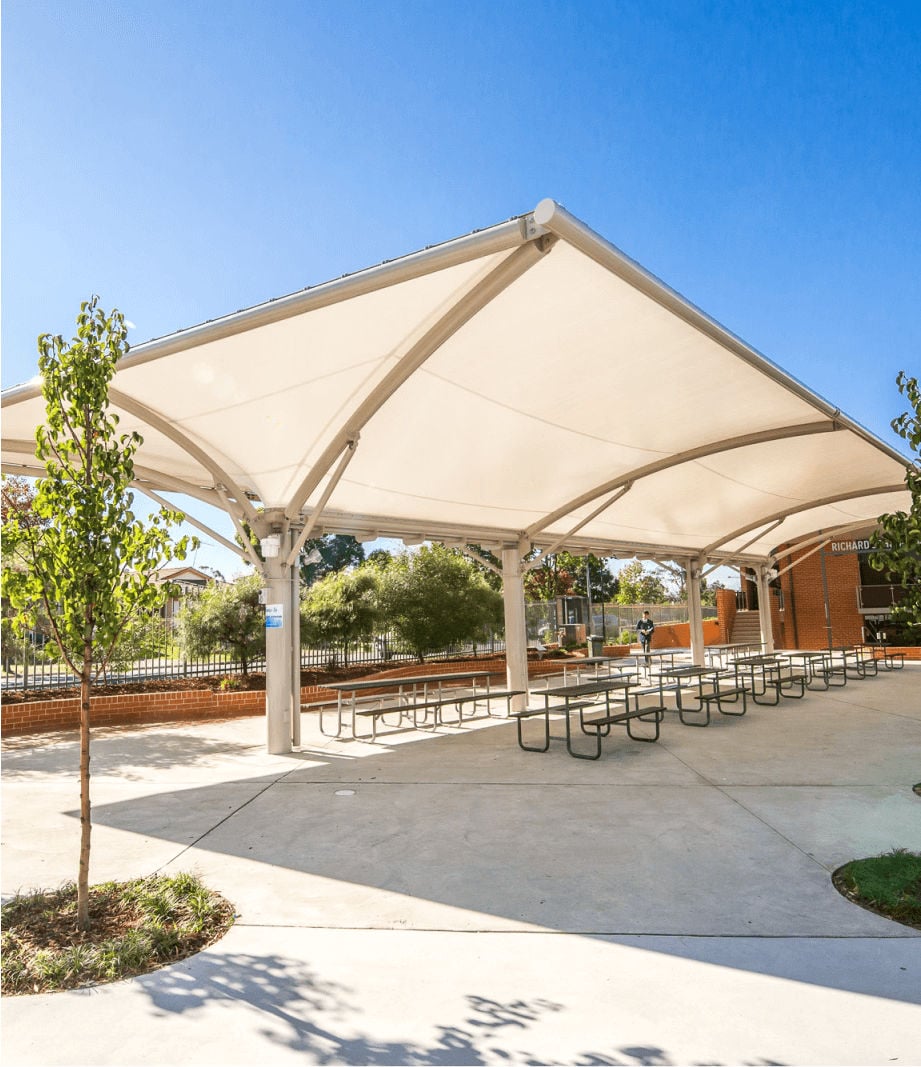
The "third spaces" that exist between formal academic buildings (lawns, terraces, and shaded hubs) serve as the vital connective tissue of a modern campus. These zones function as informal meeting and study areas where students naturally converge.
Research, including The Department of Education’s “Belonging” review, indicates that these environments are instrumental in reducing social isolation, particularly for first-year and international students who rely on visible, accessible social cues to integrate into campus life.
By providing a comfortable setting for spontaneous peer interaction, schools can significantly increase "dwell time," which in turn strengthens the overall institutional culture and student retention.
Leading Australian institutions are already re-centering their masterplans around these social hubs. The University of Melbourne’s Student Precinct, the UNSW Village Green, and the UTS Alumni Green all demonstrate a change toward treating the outdoors as a primary learning asset and seeing “community and belonging” as design goals.
Implementing your shade ideas on campus
The most successful campus transformations begin with a simple observation: what areas are students currently avoiding? Identify the transit lines where people rush because of heat, or the courtyards that sit empty during a light drizzle. These are your greatest opportunities for activation.
At Greenline, we specialise in bridging the gap between high-level policy and daily campus use. We provide the cost-certainty and low-disruption workflows required to deliver high-performance infrastructure within tight academic calendars.
If you’re ready to see how the right shade can multiply the value of your existing space, contact our team to discuss your project. We’ll help you design an environment where comfort enables connection all year round.
Want to get a sense of costs before you speak to anyone? Use our Project Estimate Tool for a preliminary budget range.