
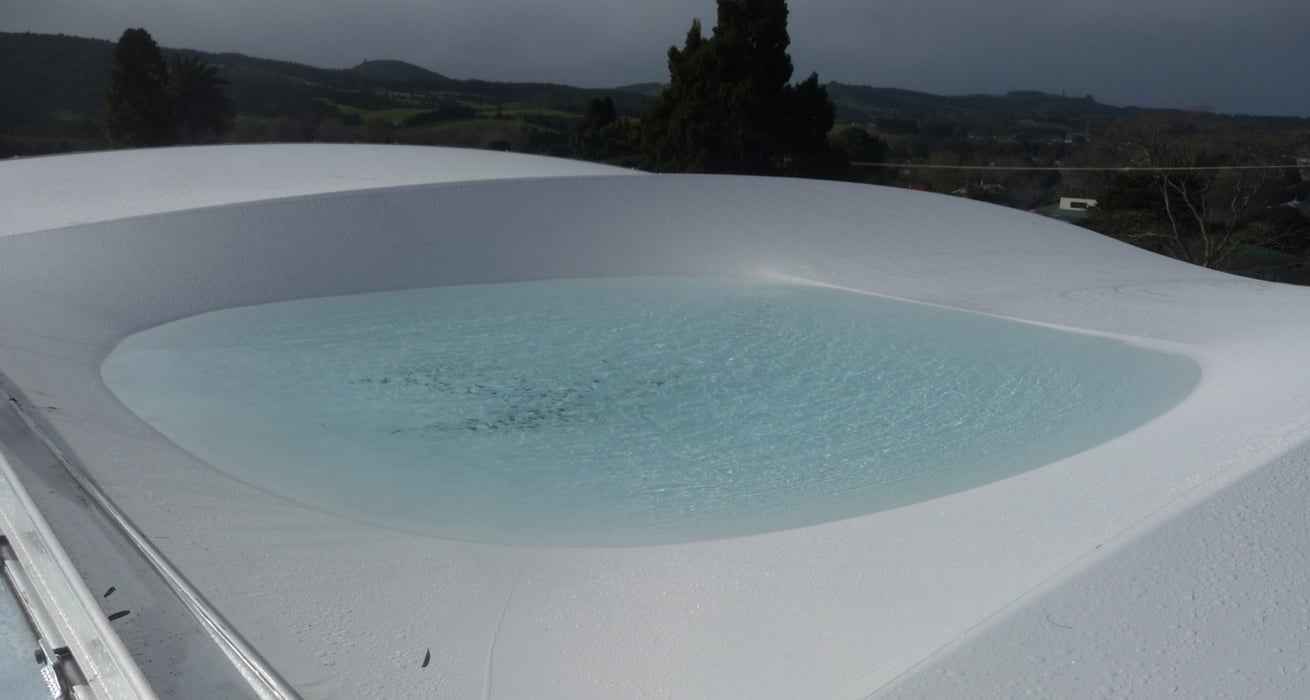
Ponding is one of the failure modes of tensile membrane structures. It rarely announces itself at the design stage, yet it remains one of the most common contributors to fabric distress, deformation, and in worst cases, structural collapse.
For architects, the risk is not limited to drainage performance. Ponding reshapes roof geometry over time, alters load paths, and undermines the long-term behaviour that tensile systems rely on to remain stable. Unlike conventional roofing, tensile membranes do not tolerate flatness, deflection, or loss of tension.
Their safety depends on maintained curvature, controlled prestress, and predictable runoff. When those conditions are compromised due to poor design or maintenance gaps, the ponding issue inevitably starts to creep up.
This article examines ponding as a design risk. It also explains how early design decisions determine whether a structure will shed water cleanly for decades or deform progressively.
Ponding explained
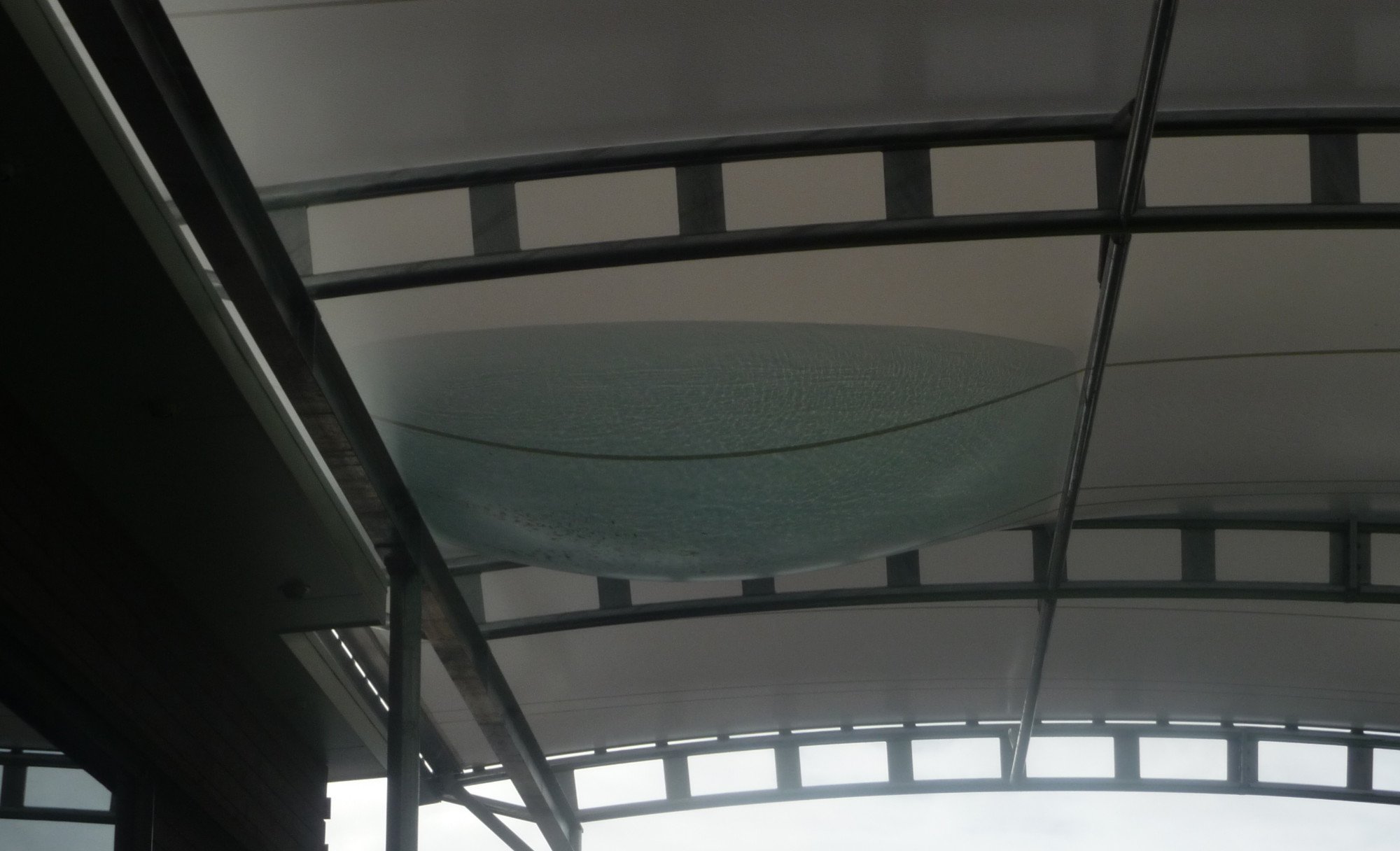
Ponding refers to the accumulation of rain water on the surface of a tensile fabric structure. This is a critical concern because tensile membranes are designed to be in tension, and when water pools on them, it creates a localised load that causes the fabric to sag further.
This sagging creates a deeper depression, which allows more water to collect, leading to an undesirable positive feedback loop. If unchecked, ponding can cause:
- Stress concentrations that exceed the fabric's capacity
- Potential structural failure or tearing
- Damage to supporting cables and frames
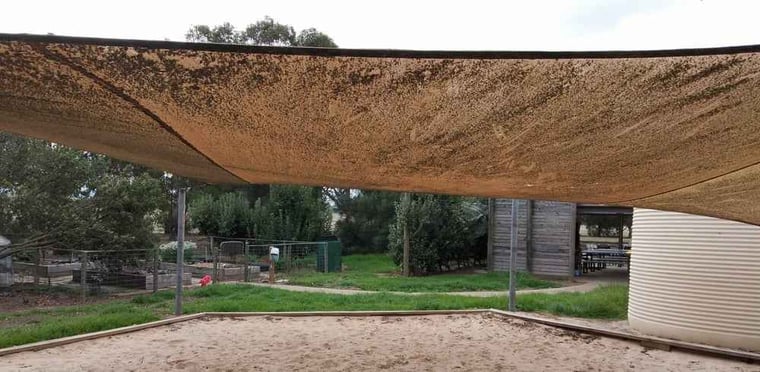
This is most prevalent on waterproof membranes, however, with porous shade fabric, it’s less of a structural concern. Water ponding on shade fabric will typically drain away over time, but can leave dirt, cause wrinkles and subject the fabric and supporting elements to higher tension than they were designed for.
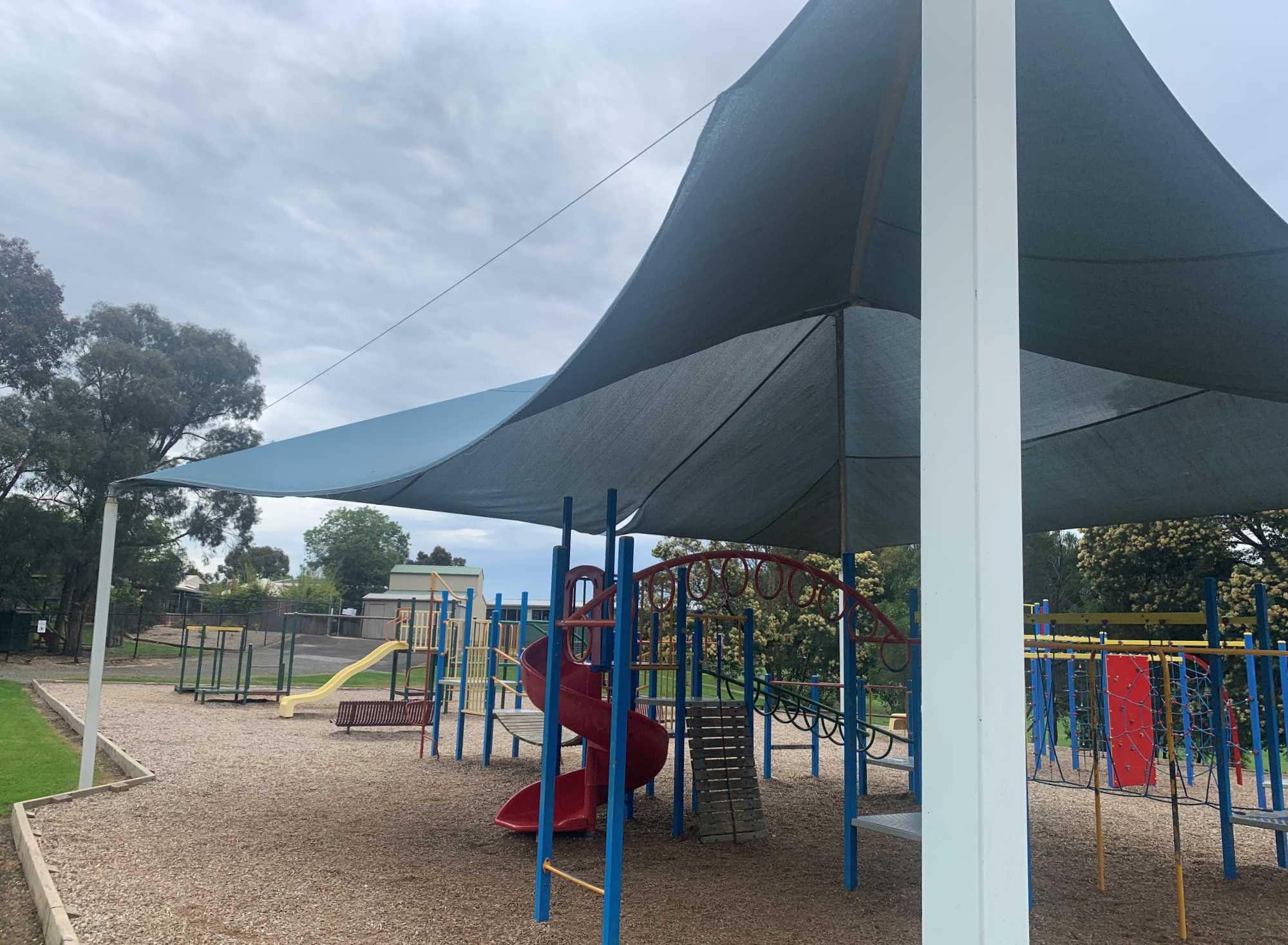
Typically, a tensile roof will have an anticlastic shape (like a Pringles chip). This shape is effective for maintaining the membrane’s form as it naturally resists ponding and provides a point for water to drain off at.
In contrast, flat roofs are susceptible to ponding unless adequate drainage provisions are made. For example, a drain-off point at the lowest part on a roof can allow water to escape without affecting the membrane of the structure.
However, this should be considered alongside the need for protection of any elements underneath the structure. This might warrant some creative plumbing.
Even with a rounded shape, ponding might still occur which is why analysis of the membrane in appropriate software should be undertaken by an experienced tensile engineer.
Before ponding can be understood, the fundamentals of tensile architecture need to be clear. These structures don’t work like rigid roofs, and their performance depends on choices made long before fabric is cut or cables are tensioned.
Factors contributing to ponding risk
Ponding is usually the result of multiple, compounding factors that gradually undermine membrane geometry and tension. Insufficient curvature limits the surface’s ability to shed water, while inaccurate patterning or panel geometry can introduce unintended low points from the outset.
Installation-related issues, particularly uneven or inadequate pre-tensioning, further reduce stiffness and make the membrane more responsive to water loading. Drainage detailing plays a parallel role. Poorly located or undersized outlets can trap water even when overall geometry is sound.
Over time, movement in columns, footing settlement, or frame deflection can subtly alter boundary conditions, redistributing forces and creating new catchments. These effects are often intensified by material creep and long-term relaxation, which reduce prestress and flatten the surface.
When combined with later modifications or retrofits that were not accounted for in the original design, these changes can push an otherwise stable structure into a progressive ponding condition.
Why it’s undesirable
The risk of ponding lies in how it rewrites the load path of a tensile structure. As water accumulates, weight concentrates in localised areas, increasing downward force and pulling tension away from other parts of the membrane.
Generic shade structure for reference only, not an actual Greenline installation.
This redistribution is not linear. Small changes in geometry can trigger disproportionate increases in stress elsewhere, particularly at edges, cables, and connection points. Elements that were designed for balanced, predictable forces are suddenly required to resist conditions outside their intended range.
It is reasonable to ask why these systems are not simply overengineered to accommodate this. In practice, tensile structures already carry conservative safety margins, but designing for sustained water accumulation is inefficient and counterproductive.
It adds cost, increases foundation and connection demands, and still does not address the progressive nature of ponding, which tends to worsen as geometry and prestress degrade over time. Preventing it through form, tension, and drainage is both more reliable and durable than attempting to resist it structurally.
Beyond immediate structural concerns, ponding accelerates material deterioration. Repeated large deflections fatigue the fabric, leading to wrinkling, seam distress, or tearing. Prolonged water retention also promotes staining, biological growth, and dirt accumulation, all of which shorten service life.
While water pooling can also affect rigid roof systems, in tensile membranes the consequences are magnified because the roof surface itself is the structure, not just a weathering layer.
How to avoid it
Preventing ponding starts at the design stage, not after water appears on the surface. It requires deliberate coordination between form, tension, and drainage so the membrane consistently sheds water under changing loads and over time.
The strategies that follow focus on resolving ponding risk through geometry and prestress, rather than attempting to manage its consequences once deformation has already begun.
Geometry optimisation
Geometry is the first and most effective control against ponding. As outlined earlier, a membrane roof begins with form-finding, where a three-dimensional shape is developed to achieve stable double curvature under wind and rain loading.
This process establishes clear high points and low points, allowing water to move predictably toward drainage paths rather than collecting in unintended depressions.
Saddle-shaped, anticlastic forms, discussed previously, are particularly effective because they promote stiffness and directional flow, whereas mono-pitch membranes (single-direction sloped surfaces without opposing curvature) rely more heavily on slope and detailing to achieve the same outcome.
In practice, a minimum fall of around 15° at any point on the surface is often sufficient to encourage runoff, but this should always be assessed in context, accounting for span, material behaviour, and expected loading.
Contemporary form-finding software allows designers to test how small changes in geometry influence deflection and water accumulation, helping identify zones that may be prone to ponding before the structure is built.
Get the tensioning right
The second factor is prestress, or how tightly the membrane is tensioned. Proper prestress keeps the fabric stiff enough to resist sagging under load. Too little tension, and the membrane becomes slack and vulnerable to ponding.
Too much, and it risks overstressing seams and connections. Because membranes relax slightly over time, engineers often design for a specific range of prestress that allows for future adjustment without losing form. Which brings us to calculation methods.
Analysis and calculation
Ponding risk needs to be verified through analysis rather than assumed to be resolved by form alone. Assessments are typically carried out using conservative material properties and reduced prestress values to reflect the fabric’s condition later in its service life, not just at installation.
Computational modelling, most commonly through finite element analysis, allows designers to simulate water accumulation as a hydrostatic load that interacts with membrane deformation.
These models test how the structure responds under combined actions, including self-weight, wind, rain, and, where relevant, snow, ensuring that load combinations reflect realistic worst-case scenarios. Both static and dynamic effects are considered, as ponded water can change shape and depth under wind-driven conditions.
Safety factors and applicable design standards provide baseline requirements, but the intent of analysis is to identify localised weak zones where small geometric changes could trigger disproportionate deformation, allowing those risks to be addressed before construction.
Wind, rain, and dynamic load interaction
Ponding risk increases when wind and rain act together rather than in isolation. Wind pressure can deepen existing water catchments by pushing the membrane downward in localised zones, while uplift and negative pressure regions elsewhere pull tension away from areas already carrying water weight.
This interaction can induce flutter at the edges of ponded regions, destabilising the membrane and allowing water to migrate unpredictably across the surface. During severe storms or cyclonic events, rapidly changing pressure patterns and high rainfall intensity can overwhelm drainage paths that perform adequately under normal conditions.
In these scenarios, the membrane’s ability to maintain shape under dynamic loading becomes critical, as even short-term water accumulation can trigger disproportionate deformation.
Preventative maintenance and remediation strategies
Even a well-resolved tensile membrane structure will experience gradual change over its service life. Material relaxation, environmental exposure, and minor movement at supports can subtly alter geometry, making regular inspection essential for identifying early signs of tension loss or emerging water catchments.
Routine maintenance typically includes checking and adjusting cable tensions, confirming that prestress remains within the intended range, and keeping drainage paths clear of debris so runoff is not obstructed.
After major weather events, targeted inspections help confirm that the membrane has returned to its intended shape and that no deformation has been locked in.
When issues are identified early, remediation is often straightforward. Re-tensioning protocols can restore stiffness and geometry, while local pattern modifications or panel replacement may be used to correct persistent low points.
In some cases, introducing additional high points or refining drainage features provides a more durable solution than increasing tension alone. Where ponding has caused deeper structural implications, a broader assessment may be required to determine whether reinforcing supporting elements or replacing sections of membrane is the most effective response.
Long-term monitoring, supported by documented inspections and clear emergency procedures for water removal, allows existing structures to be managed proactively rather than reactively, extending both performance and lifespan.
Leverage our expertise
Addressing ponding risk early, at concept and form-finding stage, is far more effective than correcting it once a structure is built. We bring deep expertise across consult, design, and construct, allowing ponding risk to be tested, refined, and resolved before it becomes a long-term issue.
If you are exploring a tensile concept and want confidence in how it will perform in practice, our team can help you model, assess, and deliver a structure that remains stable, efficient, and reliable over time.
Featured Image: Generic shade structure for reference, not an actual Greenline installation.