
If you’ve heard of terms like "terrain category 2" or "TC2: in project meetings and weren’t quite sure what it meant, you’re not alone. It’s one of the key inputs engineers use to describe how exposed a site is to wind, based on what surrounds it and how open the area is.
When designing canopies, shaded walkways, or covered courts, engineers look beyond the broader wind region and assess how wind behaves at the specific site, because that local exposure can change structural demands in a meaningful way.
This guide explains terrain categories, shielding, and importance levels, and shows how these factors influence structural design choices and project cost for shade structures across Australia.
How wind exposure changes with surroundings
The concept of terrain categories hinges on the fact that wind does not behave the same way everywhere (more on this in our article on wind regions).
As wind moves across open, unobstructed landscapes, it accelerates and retains more energy closer to the surface. Conversely, it’s slower and behaves differently near ground level when it passes over densely built areas.
Both are valid locations to build in, but the wind loads that engineers must design for are different, as they inform the sizing and geometry of load bearing members, joinery detailing, and how the foundation should be treated before building.
Terrain categories and their classifications give engineers a dependable specification to account for varying wind loads so the final design is safe, compliant, and appropriate for its actual exposure conditions.
Terrain categories explained
Put simply, terrain category describes how sheltered a site is from the wind. It considers the size, height, and spacing of everything surrounding your project (buildings, trees, landforms) and how collectively they disrupt wind before it reaches your structure.
Open sites see strong, relatively uniform airflow; built-up surroundings create slower but more complex, turbulent conditions. AS1170.2 formalises this into five classifications, ranging from wide-open exposed sites through to dense urban environments. Let's unpack each one.
TC1: open, exposed terrain
TC1 includes very open, flat terrain with almost no obstructions. In Australia, this usually means beachfront precincts, coastal rural land, river floodplains, and open agricultural plains.
Because wind can travel long distances with little resistance, near-ground wind speeds stay high. In practical terms, that means higher uplift, stronger suction at edges and corners, and more demand on the load path through the frame and into the foundations.
This requires heavier primary framing, stiffer bracing, and wider footings to keep everything stable, which will also drive up the cost of your project.
TC2: Open terrain with scattered obstructions
Open terrain with scattered obstructions such as low buildings, farm structures, or isolated trees. Rural areas and low-density outer suburbs often fall into this category, where development is present but widely spaced. Wind still has long upwind fetch (the distance it travels over consistent terrain before reaching the site) to build speed, but its flow near ground level is partly disrupted by these obstructions.
For shade structures, this typically results in lower wind demand than fully exposed sites, but still requires conservative design where exposure to prevailing winds remains high. A common application is waterfront recreational facilities set back from the shoreline, where open exposure dominates but some shelter is provided by surrounding development or vegetation.
TC2.5: transitional terrain
TC2.5 sits between open and suburban conditions and is typically used where development is emerging or uneven, such as fringe suburbs, school precincts on the edge of urban areas, or campuses surrounded by mixed-height buildings and vegetation.
These sites tend to have more natural shelter than terrain category 2, but not enough consistent obstruction to be treated as terrain category 3.
In practice, this category often suits community and education facilities in growth areas, where surrounding development is still changing but already has a noticeable influence on how wind behaves around the site. Typical examples include regional sports facilities, rural schools
TC3: Suburban and semi-built terrain
Terrain category 3 covers suburban or semi-built environments where regular housing, trees, and low-rise buildings create a more consistent pattern of shelter around a site. Many school campuses, industrial estates, sports precincts, and club facilities fall into this category, depending on what sits in the main wind direction.
In practice, this often includes urban school playgrounds and car parks, where surrounding development provides meaningful shelter but local gaps and open corridors can still allow wind to accelerate across parts of the site.
TC4: dense urban terrain
TC4 applies in dense urban areas with closely spaced obstructions like multi-storey buildings, or in places with tall, closely spaced trees. In these settings, surrounding development and vegetation break up the wind near ground level and change how it moves around a structure.
Compared with more open settings like TC1 or TC2, wind tends to be less forceful by the time it reaches roof level. This can reduce the overall load the structure needs to resist, which often allows for lighter framing and smaller foundations for the same span and layout.
That said, the wind in TC4 environments is less predictable, so detailing still matters. Connections, fixings, and overall stiffness need to be considered carefully to manage local pressure changes and movement under frequent wind events.
Most community and education projects sit in TC2.5 or TC3, with TC4 limited to dense inner-urban sites or heavily treed campuses.
What is shielding?
Shielding is about how much nearby, permanent buildings or dense vegetation break up the wind before it reaches your structure. In AS 1170.2, this is not a simple yes or no call.
Engineers look at the surroundings in a bit more detail, including how many substantial obstructions sit in the main wind direction, how tall they are compared to the structure, how close together they are, and whether they are likely to remain in place over the life of the asset.
Where shielding is genuinely effective, it can reduce how hard the wind hits structure. The catch is that this only applies in certain directions and only when the surrounding features are reliable long term. If buildings are likely to change, or vegetation could be removed, engineers are cautious about relying on it.
For open and lightweight structures, shielding is often treated conservatively because nearby development is usually outside the asset owner’s control. When there’s any doubt, shielding is commonly left out of the design assumptions to avoid underestimating wind loads.
Shielding is typically described in the following categories:
- FS (Full Shielding): The structure is surrounded by permanent buildings or dense development that provides meaningful shelter in the main wind directions.
- PS (Partial Shielding): Some nearby obstructions offer limited shelter, but exposure is still significant from other directions or through gaps.
- NS (No Shielding): The structure is largely exposed, with little to no meaningful shelter from surrounding development or vegetation.
These labels are a useful way to describe site context in plain language. Under AS 1170.2, they are not a shortcut classification. The real impact of shielding still needs to be assessed against what actually exists around the site and how likely it is to remain there over time.
“Blocked under” conditions and why they matter
“Blocked under” describes what happens at the structure itself, not what surrounds the site. It refers to situations where airflow beneath a canopy or open roof is restricted by walls, nearby buildings, balustrades, or other barriers.
An “open-under” structure allows wind to pass freely beneath the roof. This can sound similar to shielding, but they affect wind in different ways. Shielding is about what the wind flows past before it reaches the structure.
Blocked-under is about what the air can do once it gets there. Even if the incoming wind is reduced by surrounding buildings, restricting airflow beneath the roof can still increase uplift because pressure cannot equalise easily.
When airflow beneath a structure is restricted, pressure builds up under the roof and changes how wind loads act on the structure. This can increase uplift in certain wind directions and place higher demand on the structural frame, connections, and foundations.
In some layouts, blocked-under conditions end up governing design even on sites that would otherwise be considered well sheltered.
Building importance level and occupancy risk
Importance levels describe how critical a structure is in terms of safety, occupancy, and the consequences if it were to fail. They do not change how strong the wind is at a site, but they do change how conservatively the structure is designed to handle rare, severe wind events.
In simple terms, the more people rely on a structure, or the higher the risk if it fails, the more robust the design needs to be. This ensures the level of reliability matches how the structure is used over its life.
- Level 1: Minor structures with low risk to people and low consequences of failure, such as temporary or lightly used shelters.
- Level 2: Typical structures with normal occupancy and standard consequences of failure, including most community and recreational shade structures.
- Level 3: Structures with higher occupancy or where failure would have greater safety or operational impacts, such as schools and public facilities.
- Level 4: Essential or critical facilities where failure would have major consequences, including emergency services or structures that need to remain usable after severe events.
How these conditions affect project cost
TC, shielding, blocked-under conditions, and importance level all shape how hard the wind pushes and pulls on a structure, and those inputs flow through the design into material quantities, connection detailing, and foundation scope.
- TC: Affects how strong the wind is by the time it reaches roof level, which often leads to larger framing and deeper or wider footings in more exposed settings.
- Shielding: Changes how much natural protection the site gets from surrounding development, and where that protection is limited or unreliable, the structure typically needs to be designed more conservatively.
- Blocked-under conditions: Tend to increase uplift at the roof, which shows up in heavier base details, more robust fixings, and additional restraint through the frame.
- Building Importance level: Pushes up the overall design allowance, which increases member sizes and foundation scope even on otherwise sheltered sites.
Put simply, a canopy in an open coastal setting with little shelter and a higher importance level will cost more to build than the same layout in a sheltered school courtyard with a standard importance level. The aim is not to make one structure heavier than another, but to size each design to match its exposure and the real-world consequences if it were to fail.
Wind loads and shade structure design: key parameters
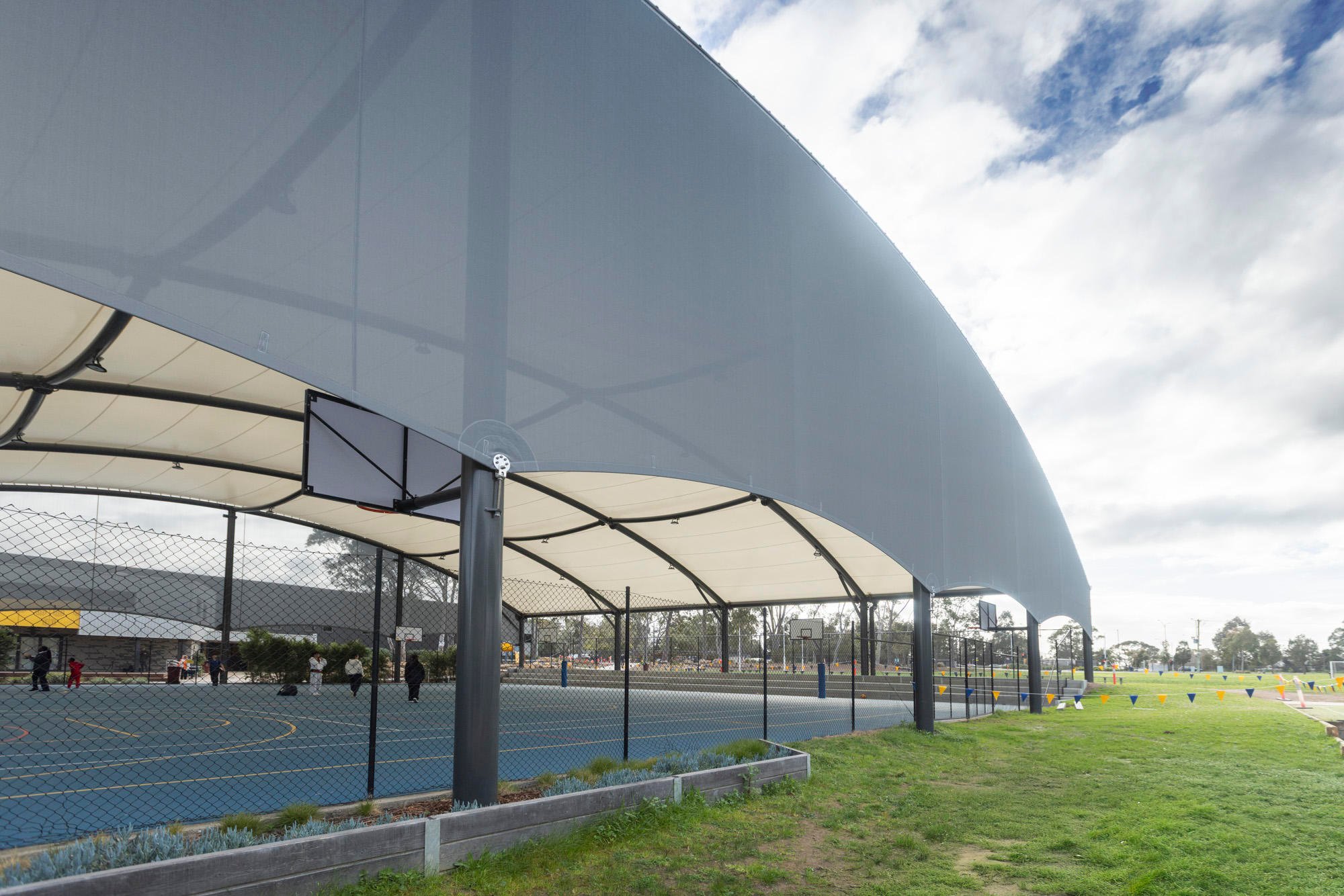
Australia's vast geography means regional wind conditions vary dramatically and are encoded directly into the structural wind actions standard. Engineers must work through a structured set of parameters to translate raw wind climate data into design decisions.
In addition to terrain categories, importance level, and shielding, here are some more factors engineers have to consider when calculating wind loads for shade structure design.
- Regional Wind Speed: The continent is divided into wind regions (A through D, plus cyclonic zones) based on historical climate data, with each region assigned a base design wind speed. Coastal Queensland and the Northern Territory carry significantly higher wind speeds than inland areas.
- Topographic Multiplier: Structures on or near hills, ridges, and escarpments experience accelerated wind, and this multiplier quantifies that amplification. Flat coastal plains and elevated highland areas are treated very differently under this factor.
- Pressure Coefficient: This factor accounts for how a building's geometry (its roof pitch, plan shape, and openings) distributes pressure across its surfaces. Windward walls receive positive pressure while leeward walls and roofs typically experience suction, and both must be designed for independently.
- Directional Multiplier: Wind doesn't blow equally from all directions, so this factor adjusts the design wind speed based on which compass direction produces the worst structural effect. In many parts, damaging winds are more likely from specific prevailing directions.
- Dynamic Response Factor: For standard low-to-medium-rise buildings this factor equals 1, but for tall or flexible structures it amplifies loads to account for resonance and oscillation. High-rise buildings in Sydney or Melbourne and structures like communication towers commonly require this dynamic assessment.
- Internal Pressure: When a building has openings such as doors, windows, or vents, wind can enter and pressurise the interior, pushing outward on the structure from inside. AS/NZS 1170.2 classifies buildings as enclosed, partially enclosed, or open to assign the appropriate internal pressure coefficient.
In summary
TC, shielding, blocked-under condition, and importance level are inputs that need to be identified early because they shape structural form, cost, and long-term risk.
Once geometry, framing, and footing layouts are locked in, correcting underestimates of site exposure or importance level usually means redesign, delays, and avoidable cost. Being conservative with exposure assumptions can add some upfront cost, but under-specifying terrain or shelter creates a long-term liability risk that is far harder to unwind later.
Early input from structural specialists helps avoid under-design and late-stage rework. If you’re assessing a site or working through an early concept and want a second set of eyes on it, we’re happy to discuss it with you.
If you want to go deeper into regional exposure, it is also worth understanding how wind regions vary across the continent and how they interact with local terrain classification in AS 1170.2.
For information on new shade structure project as well as engineering requirements and feasibility, get in touch with us for a site-specific consultation.