
Wind loads shape every decision in shade structure design, from the steel you specify to the foundations that anchor it. Those loads begin with understanding where your project sits geographically and what that means for engineering requirements.
Australian Standard AS1170.2 divides the continent into distinct wind regions based on climate patterns and cyclonic exposure.
A shade structure in suburban Melbourne faces fundamentally different wind behaviour than one on the coast in Townsville, and that difference translates directly to structural complexity, material specifications, and project cost.
However, wind regions aren't only part of the equation. This guide walks through Australia's wind regions, how it combines with other site factors to inform Wind Classifications, and what that means for your project's feasibility and budget.
Whether you're in early planning or refining a concept design, understanding these classifications early prevents costly surprises later.
What are wind regions in AS1170.2?
Wind regions are geographic zones defined by statistical wind speed data collected over decades. AS1170.2 uses this data to establish baseline design wind speeds for different parts of Australia.
For instance, the temperate south experiences different wind patterns than the cyclonic tropical north, and the standard accounts for that. Treating every site as if it faced the same wind environment would either overbuild in low-risk areas or under-build in high-risk ones.
The goal is to ensure structures can safely resist the strongest winds statistically likely to occur at their location over the building's design life.
Whether it's prevailing westerlies across inland plains or a category 4 cyclone tracking along the coast, every site has a design wind speed that must be accounted for in engineering calculations.
Wind regions establish the baseline, but other factors matter too. Regional wind speed data, terrain categories, topographic classes, and shielding classes are factored in when determining wind classifications and forces that the structure will have to endure.
Together, these datapoints inform the final design. Steel member sizes, connection capacities, cable pre-tension (if tensile), foundation embedment depth, and material specifications all stem from this starting point.
This is why two projects that look identical on paper can end up needing very different structural capacity depending on where they are built. Below we’ll explore the 4 wind regions specified under AS1170.2 standards, particularly the updated 2022 version.
Region A: non-cyclonic areas
Geographic coverage: South and inland Australia (Victoria, South Australia, Tasmania, southern New South Wales (NSW), Australian Capital Territory (ACT))
Typical locations: Melbourne, Adelaide, Canberra, Hobart, inland NSW and Victoria, Perth metropolitan area
Design wind speeds: 108-162 km/h (lower range of AS1170.2 requirements)
Complexity: Standard. Straightforward design and certification process
Cost impact: Baseline (1.0x). Most cost-effective region for building shade infrastructure
Common project types: Schools, sports facilities, community centers, car parks, playgrounds, public parks
Region A represents the majority of Australia's population centers and handles the bulk of community infrastructure projects. Design and certification processes are well-established, with most engineers comfortable working within these parameters.
Material specifications focus on standard corrosion protection rather than extreme weather resistance. Approval timelines are typically shorter, and fabricators have deep experience with Region A requirements.
This translates to competitive pricing and predictable project delivery. For clients working on standard shade infrastructure in these areas, Region A offers the most straightforward path from concept to completion.
Region B: intermediate/transitional zones
Geographic coverage: Coastal NSW, southern and central Queensland coast
Typical locations: Sydney, Newcastle, Wollongong, Gold Coast, Sunshine Coast, Brisbane
Design wind speeds: 162-198 km/h (moderate wind loading requirements)
Complexity: Moderate. Additional considerations for coastal exposure
Cost impact: 1.1-1.3x baseline. Moderately increased structural requirements
Common project types: Coastal schools, beachfront amenities, sports facilities, transit shelters
Region B sits between temperate inland conditions and tropical cyclonic zones, requiring engineers to account for coastal exposure without the full cyclonic design regime.
Salt-laden air demands enhanced corrosion protection for steel components and hardware, typically through hot-dip galvanising or marine-grade stainless steel specifications.
Wind loads step up from Region A but remain manageable with conventional structural systems. The engineering is less straightforward than inland projects but stops short of the specialist requirements seen further north.
Most fabricators handle Region B comfortably, though material upgrades and slightly heavier sections add modest cost compared to equivalent Region A builds.
Region C: cyclonic areas
Geographic coverage: North Australia's tropical belt (northern Queensland (QLD), Northern Territory (NT), North West Australia (WA), far north NSW coast)
Typical locations: Cairns, Townsville, Darwin, Broome, Port Hedland, Karratha
Design wind speeds: 198-252+ km/h (significant cyclone design requirements)
Complexity: High. Specialist cyclone engineering and extended certification
Cost impact: 1.4-1.9x baseline. Substantially increased structural, foundation, and material specifications
Common project types: Schools, community facilities, mine sites, regional infrastructure, public amenities
Region C marks a substantial jump in requirements. Cyclonic design requirements surpass wind speeds; structures must handle sustained extreme loads, rapid pressure changes, and wind-borne debris impact.
Every connection, foundation, and material specification gets scrutinised under cyclone-rated criteria. Engineers with cyclonic certification become essential, approval timelines extend, and certification processes involve additional checks.
Structural members increase in size, foundations go deeper, and hardware specifications move to higher grades. Materials must handle not just wind forces but also tropical humidity and accelerated corrosion.
Region D: severe tropical cyclone zones
Geographic coverage: Most exposed coastal strips within cyclonic Australia (typically within 5-10km of exposed coastline in northern regions)
Typical locations: Exposed coastal areas of far north QLD, NT coast, north-west coast of Western Australia
Design wind speeds: 252-306+ (extreme cyclone design requirements)
Complexity: Specialist. Often requires site-specific wind studies and advanced engineering
Cost impact: 2.0x+ baseline. May exceed feasibility for standard shade structure solutions
Common project types: Critical infrastructure only; many standard shade structures not viable or require alternative solutions (earth berms, natural shelter, hardened structures)
Region D pushes beyond what many standard shade structure systems can economically achieve. Site-specific wind studies often become mandatory, and conventional tensile membrane or lightweight steel solutions may not be viable at any reasonable cost.
Engineers frequently recommend alternative approaches: hardened structures with minimal openings, earth-integrated designs using berms or natural shelter, or relocating the project to a less exposed site.
Where shade structures do proceed, they require specialist engineering, extreme material specifications, and substantially oversized structural systems. Costs can double or triple compared to Region A equivalents.
Regional boundaries and transition zones
Wind region boundaries follow geographic and climatic patterns rather than administrative borders. AS1170.2 provides a cyclone rating and wind region map for Australia, showing these zones, typically based on distance from coastline, latitude, and exposure to cyclonic weather systems.
Reading these maps requires attention to detail, because boundaries don't always align neatly with council areas or postcodes.
Sites near boundaries require careful assessment. A project sitting close to the line between Region A and Region B may warrant conservative classification, particularly if local topography or coastal proximity creates additional exposure. Engineers often apply the higher class in marginal cases to avoid under-design.
Local councils and certifiers can interpret boundaries differently, especially in transition zones. Some authorities require the higher classification by default for sites within a certain distance of a boundary. Others assess case-by-case based on specific site conditions.
Check with your local authority early in the design process to understand their approach. What counts as Region A in one council area might be considered Region B next door, with real implications for engineering requirements and project cost.
How wind regions affect your shade structure project
When engineers apply AS1170.2 to a project, the wind region is one of the first inputs.
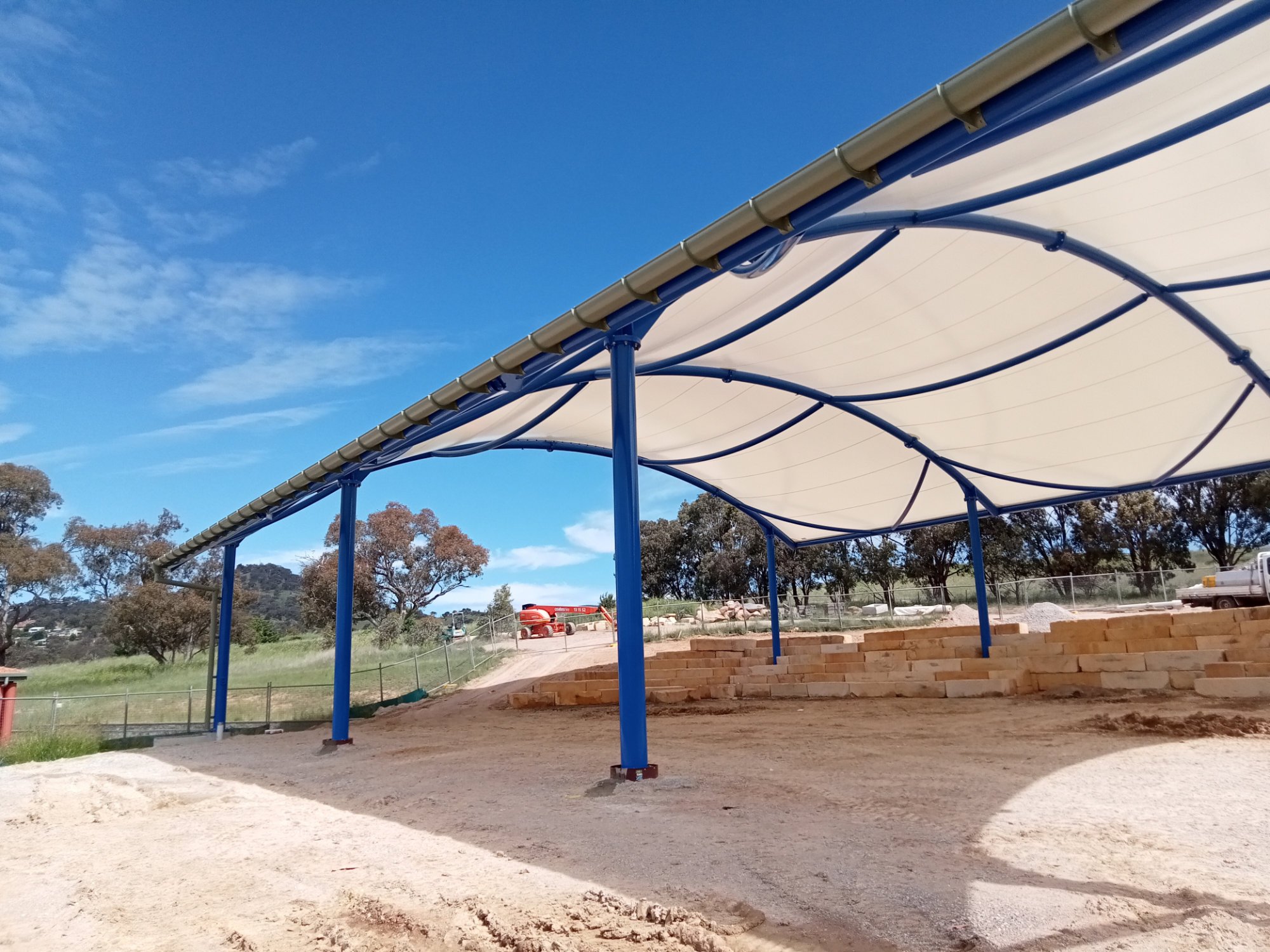
Higher wind speeds translate directly to greater load requirements. To meet those loads, structural elements scale up accordingly; steel members increase in size to resist uplift and lateral forces. Footings become deeper or wider to anchor the frame securely.
Connection details such as bolts, welds, and brackets grow in number and capacity. Cables require higher pre-tension and larger diameters. Even membrane or cladding specifications may shift to materials with greater tensile strength and tear resistance.
In cyclonic regions, additional bracing becomes necessary. Secondary structural systems that might be optional in Region A become mandatory in Region C to control lateral loads.
A canopy or COLA designed for Region A might use standard column and rafter sizes. Move that same design to a Region C site and those members will get larger, with heavier footings to match. The labour and transport costs will also be affected. For example, heavier members may require a larger crane to erect the structural steelwork.
This doesn’t mean the higher-rated structure is over-engineered; it simply reflects the conditions it must survive. Wind loads are compliance requirements under the National Construction Code. Designing below the correct region would risk failure in the event of high winds.
In certain cases the architectural design can be adjusted to mitigate some of the change, for example, lowering the roof to reduce its profile can decrease the wind loads on the structure. However, these adjustments have limits.
Eventually, the wind region dictates baseline structural requirements that design refinement alone cannot overcome. Fabric structures are particularly sensitive to wind regions. The lightweight, flexible nature of tensile membranes means they generate significant uplift forces under wind loading.
This often drives foundation requirements more than downward loads, especially in higher wind regions where uplift can demand substantially deeper or heavier footings than comparable rigid structures or buildings.
AS4055 wind classifications: T1-T4, N1-N6, C1-C4
AS4055 wind classifications (N1-N6, C1-C4) are designed for Class 1 and Class 10 buildings, which means houses, garages, and small non-habitable structures.
Commercial shade builds typically fall outside this scope and are instead designed directly to AS1170.2, using calculated wind pressures rather than simplified classification codes. That said, AS4055 classifications provide a useful reference framework for understanding how wind regions combine with site-specific factors. The standard determines wind classifications by combining:
- Wind Region (A, B, C, or D): Your geographic location
- Terrain Category (TC1 to TC4): Surface roughness around your site
- Topographic Class (T0 to T5): Whether your site is on a hill, slope, or flat ground
- Shielding Class (FS, PS, NS): Whether upwind buildings provide code-recognised shelter
For commercial shade builds, engineers use these same inputs but apply them through AS1170.2 calculations to determine design wind speeds and pressures specific to the project.
While you likely won't see N3 or C2 stamped on commercial blueprints, understanding how these factors interact helps clarify why two projects in the same wind region can have very different structural requirements.
Topographic classes
Topographic classes have to do with how the shape of the land around a site can speed wind up before it reaches your structure. Hills, ridgelines, escarpments, and sharp changes in terrain can all cause wind to accelerate and become more turbulent as it flows over them.
Engineers look at whether a site sits on or near elevated features, how steep those features are, and where the structure is positioned relative to the crest or edge. A site on flat ground behaves very differently to one perched on a ridgeline or near the top of a coastal escarpment.
The closer the structure is to the crest of a hill or ridge, the more pronounced the speed-up effect tends to be. Topographic exposure is described using classes from T0 to T5:
- T0: Flat or gently undulating land, with slopes typically under about 3°, and no nearby hills, ridgelines, or escarpments that would change wind flow at the site.
- T1: Low, broad slopes, generally in the order of 3° to 5°, where the surrounding landform has little influence on wind behaviour at roof level.
- T2: Moderately sloped terrain or low ridges, often around 5° to 10°, where some local wind speed-up can occur, particularly near the upper parts of the slope.
- T3: Prominent hills or ridgelines with slopes commonly in the range of 10° to 15°, where wind speed-up becomes noticeable as structures approach the crest.
- T4: Steep hillsides or escarpments, typically 15° to 20° or steeper, where wind can accelerate sharply near the top edge or break in slope.
- T5: Highly exposed ridgelines, cliff edges, or sharp escarpments with steep slopes and abrupt changes in terrain, where wind acceleration is strongest and most persistent, especially for structures located close to the crest or edge.
Topographic effects are highly site-specific.
A location can be surrounded by development and still experience amplified wind if it sits near a crest or escarpment. Because landforms are permanent, engineers place more weight on topographic class than on shielding from nearby buildings, which can change over time.
Non-cyclonic: N1-N6
The “N” stands for non-cyclonic. These classes describe how strong the wind is expected to be at a residential building site in non-cyclone regions of Australia. The higher the number, the stronger the design wind the house must be built to resist.
Regions A and B use N-class designations:
- N1 (W28, ≈100-122 km/h): Very low wind exposure. Rare in practice and usually only applies to very sheltered sites.
- N2 (W33, ≈119-144 km/h): Typical suburban housing conditions in non-cyclonic regions. This is the most common class for houses in established suburbs.
- N3 (W41, ≈148-180 km/h): Higher wind exposure than a typical suburban block, such as more open sites, hilltops, or coastal fringe suburbs.
- N4 (W50, ≈180-219 km/h): Very high wind exposure in non-cyclonic regions, often open or elevated sites with little surrounding shelter.
- N5 (W60, ≈216-266 km/h): Extreme non-cyclonic wind exposure. Applies to highly exposed coastal headlands, elevated open sites, or exposed ridgelines in non-cyclonic regions.
- N6 (W70, ≈252-309 km/h): Maximum non-cyclonic classification. Reserved for the most severe non-cyclonic wind patterns, such as fully exposed coastal clifftops or extreme topographic locations in Regions A or B.
For most builds, the equivalent housing exposure aligns closest to the N2 wind rating. More exposed sites, such as large open areas or critical public facilities, can align more closely with N3. These classes sit on top of wind region and site exposure, which together determine the final design wind level.
Cyclonic: C1-C4
Regions C and D use C-class designations to represent much higher wind loads expected in cyclonic parts of Australia. These classifications account for the extreme wind events possible in northern regions, with C1 at the lower end of cyclonic exposure and C4 representing the most severe environment.
In the most exposed parts of Region D, many terrain and topography combinations fall outside the standard tables and are marked “NA,” which signals that simplified approaches are no longer suitable and specialist input is required.
- C1: Lower cyclonic wind exposure. Applies to relatively sheltered places within cyclonic regions, such as suburban areas with surrounding development in northern cities.
- C2: Moderate cyclonic wind exposure. Common class for typical residential and commercial sites in cyclonic regions with some terrain shelter.
- C3: High cyclonic wind exposure. Applies to more open or elevated sites in cyclonic regions, or coastal areas within the tropical belt.
- C4: Severe cyclonic wind exposure. Reserved for the most exposed sites in cyclonic regions, such as coastal headlands, offshore locations, or places with minimal shelter in Region D. Many C4 scenarios require specialised solutions.
Our approach
Wind region categories in Australia set the foundation for shade structure design across the continent, but every project requires a degree of personalisation to fit unique requirements, even though the design may be identical.
Through our Consult Design Construct methodology, we work collaboratively with structural engineers from the earliest stages to understand what influences your site, whether that's cyclonic exposure, elevated topography, coastal corrosion, or architectural complexity.
If you're considering a new shade structure project and want information on engineering requirements and feasibility before committing to a design direction, we're available for site-specific consultation.