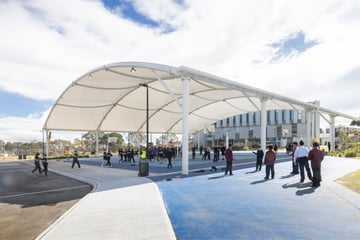

Outdoor schooling is any structured educational activity that moves learning beyond the traditional classroom into covered or open-air outdoor environments. Growing evidence links it to stronger student engagement, improved wellbeing, and fewer behavioural disruptions. Schools across Australia are rethinking how their outdoor spaces get designed, built, and used on the back of that evidence, and the infrastructure question sits at the centre of the shift.
We've delivered 600+ projects since 2020 and are trusted by thousands of schools across Australia, operating since 1997. In our experience, the schools getting the most from outdoor schooling are the ones that plan infrastructure around how the space will actually be used before any structural decisions get made. This article walks through what outdoor schooling is, why more schools are investing in it, what the infrastructure looks like in practice, and what to think through before briefing a project.
What outdoor schooling is
Outdoor schooling is any deliberate use of outdoor space for teaching, learning, or student activity. It covers a wide spectrum: Year 5 students studying ecosystems in a garden, PE classes on covered courts, whole-school assemblies under steel canopies, and early learners in nature play areas. What unites them is deliberate planning. The outdoor environment is chosen as the learning setting, not incidental to it.
The terminology can get confusing because schools and educators use "outdoor learning" and "outdoor education" to describe related but distinct concepts. "Outdoor Education" is a standalone academic field often described as distinct from other curriculum areas because it delivers student outcomes no other discipline does. The Australian Curriculum, however, uses the term "Outdoor Learning" rather than Outdoor Education. "Outdoor schooling," as used in this article, is the broader umbrella that sits over both. It includes outdoor education as a subject, and it also covers every other deliberate use of outdoor space across a school's daily operations: sport and PE, assemblies, project-based learning, and community events.
You benefit from better outdoor spaces regardless of whether you run a formal outdoor education program. Any school that teaches, gathers, or plays outside is engaged in outdoor schooling, whether that term gets used or not.
ACARA (the Australian Curriculum, Assessment and Reporting Authority) categorises Curriculum Connections as resources developed to support educators to draw connections across seven themes, including Mental Health and Wellbeing, Outdoor Learning, Consumer and Financial Literacy, and Food and Fibre. The Curriculum Connection for Outdoor Learning identifies opportunities for students to experience guided, integrated learning across the curriculum in natural environments, building knowledge, skills, and a positive relationship with nature along the way. That framing positions outdoor learning as a core educational approach, not an optional add-on.
In practice, outdoor spaces can carry curriculum delivery across multiple learning areas. Content from Health and Physical Education, Humanities and Social Sciences, Geography, Science, and cross-curriculum priorities can all run through learning in the outdoors (Foundation to Year 6) and outdoor education (Years 7 to 10). A covered outdoor area doesn't only serve PE. It hosts geography fieldwork, science observations, and collaborative projects that draw on several subjects at once. Consistent delivery across all conditions depends on quality infrastructure. Our covered outdoor learning areas let schools teach outside year-round, turning open courtyards and courts into usable spaces on days when sun or rain would otherwise push everyone back inside.
Why more schools are investing in outdoor schooling
Schools are making these investments on practical grounds: student safety, scheduling reliability, documented wellbeing outcomes, and capital funding that can offset project costs. Three converging factors are driving the pattern.
Student health and UV protection
Around two in three Australians will be diagnosed with skin cancer by age 70 according to Cancer Council Australia. Australia's skin cancer rate sits among the highest in the world, which makes UV protection a genuine safety obligation, not an optional upgrade.
Students need to be outside. Physical activity, fresh air, and natural light all support healthy development. Unprotected sun exposure during school hours, though, carries serious long-term risk. Covered outdoor structures give you a way to get students outside safely, with 90 percent or greater UV protection built into the structure itself. The broader health picture reinforces the case. Childhood obesity, vitamin D deficiency, and myopia are all rising in Australia, with sedentary lifestyles identified as a contributor. Time spent outdoors, moving and active, works directly against those trends, and covered outdoor spaces make that time accessible across the school day rather than only on the rare day with perfect weather.
Weather resilience and year-round usability
Without covered areas, schools lose significant teaching and activity days to weather. Sydney averages 122 rain days per year according to Bureau of Meteorology data, and that loss repeats year after year. When South Australia's Department for Education invested in covered outdoor learning areas, the explicit goal was to give teachers a dedicated space to run learning in an open, natural setting without having to improvise when conditions changed. Teachers gained scheduling certainty, and lessons planned outdoors could actually happen outdoors.
Schools that invest in covered courts and outdoor learning areas effectively reclaim those lost days. A structure that extends outdoor usability across more months of the year delivers value every operating year, not only in year one.
Engagement, wellbeing, and academic outcomes
Research confirms the educative power of outdoor learning for personal development and academic outcomes. There's consensus across high-income countries (Australia, Canada, Denmark, the UK) that outdoor education contributes positively to general health and wellbeing, student motivation, engagement, and connection to nature. Integrating experiential outdoor education into K-12 curricula has been shown to improve standardised test performance, reduce classroom management problems, and lift engagement and motivation (James and Williams, 2017). A systematic review of 147 studies identified increased student engagement and ownership of learning, alongside evidence of academic improvement, as consistent findings.
The stress and attention research points the same direction. A longitudinal study in Germany compared students taught using an outdoor curriculum in a forest against a control group in a standard classroom, measuring cortisol levels across the school year with one full day per week spent outdoors. The outdoor group showed healthier cortisol regulation patterns. A separate four-year study of 562 Norwegian preschoolers found a positive relationship between outdoor hours and attention scores, and an inverse relationship between outdoor hours and inattention-hyperactivity symptoms.
Together, these findings confirm that a well-designed outdoor space extends instructional time, reduces behavioural disruptions, and increases daily physical activity. Those outcomes directly affect academic engagement and student growth, and they depend on the infrastructure that makes consistent outdoor learning possible.
Government funding and infrastructure investment
The Schools Upgrade Fund is a $283.4 million Australian Government investment that helps schools meet the cost of new infrastructure projects, including upgrades to playground and outdoor learning facilities, with $215.8 million available under Round 2 to support government schools with important infrastructure projects including new outdoor learning spaces. Only government schools can apply for the Schools Upgrade Fund Open Round, so if you're at an independent or Catholic school, state-level capital programs are where to look. Victoria has committed $450 million to help build and upgrade low-fee Catholic and independent schools across the state, and similar programs exist in other states. Our grant resources page covers both federal and state-level programs so you can identify what applies to your sector.
New school builds reinforce the direction. Gledswood Hills High School in NSW was designed with covered outdoor learning areas, sports courts, and playing fields built in from the start, which reflects a shift in what education departments and school communities now treat as standard infrastructure.
What outdoor schooling looks like in practice
Outdoor schooling infrastructure varies by school size, budget, and usage goals, but three categories of structure cover most of what Australian schools build. The examples below show how schools translate the concept into daily operations through physical infrastructure.
Covered outdoor learning areas (COLAs)
The COLA is the most substantial expression of outdoor schooling infrastructure. These are large-span steel-framed structures built to provide all-weather coverage over outdoor courts, assembly areas, and open play spaces. A well-designed COLA lets you run PE, whole-school assemblies, outdoor classes, and community events without weather being the deciding factor.
Following the 2007 government investment that rolled out COLA funding across Australian schools, the COLA has become a standard feature in school infrastructure planning across the country. It shows up as a common element of well-equipped campuses rather than an exception.
Structurally, COLAs come in several roof profiles. Gable roofs offer a clean, symmetrical pitch suited to larger spans. Curved or barrel-vault profiles give you an architecturally distinct look with strong water runoff and light distribution. Skillion roofs work well where a single-pitch design fits the site or building context. Spans typically run from 10 metres to 50+ metres depending on the area you need to cover. A COLA can be built with either a steel roof or a fabric membrane roof, because the term describes how the space is used, not what it's built from. Both steel roof structures and fabric structures work for COLA applications, and the right choice depends on span, aesthetic fit, and how the space will actually be used.
Fabric structures and shade sails
Not every outdoor schooling need calls for a full COLA. Fabric structures, including tensile membranes, barrel vaults, and commercial shade sails, handle a different but equally important set of use cases. These are the structures you see over playgrounds, outdoor dining areas, smaller gathering zones, and undercover walkways between buildings.
Fabric suits school environments well because it provides UV protection while still transmitting natural light. Quality tensile membranes typically transmit 9 to 25 percent of daylight through the roof. Higher transmission rates (20 to 25 percent) suit outdoor classrooms where bright, open conditions matter, while lower rates (9 to 15 percent) give stronger UV control for play areas. That contrasts with opaque roofing, which blocks daylight and creates an enclosed feel rather than a genuine outdoor learning environment.
Fabric structures, and shade sail application,s are also typically faster to install and more cost-effective for smaller coverage areas, which makes them a practical first step if you're building toward a broader outdoor schooling strategy across several phases.
Multi-sport outdoor facilities
If you're bussing students to off-campus facilities for basketball, netball, or volleyball, you're paying ongoing transport and facility-hire costs that an on-site covered court removes. Having the facility on campus also gives you scheduling flexibility external venues can't match.
Schools are increasingly building covered outdoor courts that serve multiple functions across the week: PE during the day, inter-school competition on weekends, community hire outside of school hours. On-site availability usually means higher participation, fewer logistical constraints on sport programming, and a venue that can host programs the school previously had to outsource. Covered basketball and netball courts accommodate several configurations within a single structure and can be built to competition standard, serving both curriculum and community purposes. Our outdoor sports facilities for schools cover a wider range of configurations than most business managers expect on a first call.
How to brief an outdoor schooling project
Successful outdoor spaces start with clarity about intended use. The schools that end up with outdoor areas they use consistently are the ones that asked the right questions at the start of the process.
Start with how the space will be used
Defining your usage goals before design keeps you out of costly redesigns and produces a space you'll actually use. The planning conversation should spell out intended use: PE and sport in all weather, outdoor classrooms, assemblies, community hire, or several of those at different times of the week. Each goal drives different design decisions around span, roof profile, surface treatment, orientation, and integration with adjacent buildings.
If you haven't yet defined those goals, that's a normal starting point. The consult stage is designed to help you get there before any design work begins. Ask yourself three questions before briefing a project. What do you currently cancel or relocate because of the weather? What would you timetable into the space if it were reliably available year-round? How many students need to use it at once? Those answers place the project in the right cost bracket and give any design team enough information to start a meaningful conversation.
Site variables: weather, orientation, drainage
Once usage goals are defined, the site itself needs careful analysis. Prevailing wind and rain direction determines where screening or partial enclosure is worth specifying. The sun path across the site determines whether the space stays comfortably shaded when it's most used or whether heat becomes a problem in certain seasons. Drainage needs to be designed into the structure from the start, not patched after water starts pooling. Getting these factors into the brief at the outset avoids the category of issues that show up on handover and frustrate staff afterwards.
For outdoor classrooms and assemblies, acoustic design matters equally. The right roof geometry and material (fabric or translucent panel over a steel frame, or a well-specified metal roof with acoustic treatment) supports both sound performance and the visual openness that distinguishes a genuine outdoor learning environment from an indoor space with a roof.
Compliance, approvals, and funding
Covered outdoor learning areas, covered courts, large fabric structures, and fixed outdoor classroom installations typically need council approval or a Development Application before construction begins. Outdoor learning environments (including nature play spaces, outdoor classrooms, and fixed play equipment) have to comply with applicable safety and accessibility standards from the project start.
The approvals process runs smoother when it's planned for upfront rather than treated as a final step. A design and construction partner experienced with school projects will know what documentation is needed in your jurisdiction and how to put a submission together efficiently.
On the funding side, grants are available to offset project costs, and accessing them early in the planning process means you can design to a budget that reflects what's actually funded rather than guessing. Our grant resources page covers federal and state programs for Australian schools, and knowing what's accessible before committing to a design scope can make a meaningful difference to what you can afford to build. Our Consult. Design. Construct. methodology is structured to work through compliance, approvals, and funding as part of the project process, so those pieces don't fall to your facilities team to figure out alone.
Our approach to outdoor schooling projects
Our Consult. Design. Construct. methodology starts with understanding how the space will be used. We don't present a standard product and fit your school around it. Whether you're considering a COLA over an existing court, a fabric structure for a play area, or a full covered multi-sport facility, the first step is always a conversation about use.
One team stays accountable from the first site conversation through to handover, with a locked-in budget confirmed at the consult stage. No handoff gaps between architect, engineer, and builder. One point of accountability. Early engagement reduces risk, because the site and brief unknowns get resolved before the budget is locked rather than surfacing as variations after construction starts.
When we build on a live school campus, we fabricate offsite and install onsite, whether the roof is steel or fabric. That compresses the disruption window on your grounds. Noise, dust, and contractor traffic get concentrated into a much shorter period than full on-site construction, which means business as usual for your staff and students through most of the build. Fewer headaches at the timetabling level, less coordination work for your facilities team, and a shorter on-campus footprint for the work.
What we don't build
For the sake of clarity, we don't build demountables, modular buildings, small timber pavilions, or basic park shelters. If one of those is what your school actually needs, a different provider will be the right call. Our work sits in permanent, large-span, waterproof covered outdoor structures built for daily school use: sports courts, assembly spaces, multi-use covered outdoor learning areas, and architectural fabric and steel structures designed around how the space will actually be used across the school year.
Start with a conversation
You don't need all the answers before making contact. The consult phase is designed to help you define your usage goals, work through your site variables, and see what's realistic within your budget and timeline.
Two options depending on where you're up to. If you want a ballpark figure before committing to a detailed conversation, our Project Estimate Tool gives you a working budget range based on your space and coverage requirements in a few minutes. If you're ready to walk through your site, use cases, and timeline, you can discuss your project with us and we'll cover site conditions, activity requirements, and budget in a single call.
Start with whichever fits. We're here when you need us, even if just to start with a forecast comes budget time.